
Where it took place
| Type | Place |
|---|---|
| Region | Latin America |
| Country | Chile |
Campaign at a glance
A coalition of labour unions, students, political parties and poor neighbourhoods organised monthly national protests — the Protestas Nacionales — against the military dictatorship of General Augusto Pinochet from May 1983 to October 1988 [source: nv-database]. The protests combined street demonstrations, protest strikes, lightning actions and national strike days, and contributed directly to the 5 October 1988 plebiscite in which 55 percent of Chileans voted NO on Pinochet’s continuation in power, forcing democratic elections and an end to the dictatorship [source: nv-database].
Tactics used
- nonviolent direct action
- marches
- strikes
- cacerolazos (pot-banging)
Background
On 11 September 1973 a military coup forced the democratically elected President Salvador Allende out of power and General Augusto Pinochet established a dictatorship that lasted nearly seventeen years [source: nv-database]. After 1980 an economic crisis began to undermine Pinochet’s claim of technocratic competence, and an initial 1982–83 recession created space for organised labour to test the regime’s tolerance for public protest [source: nv-database]. In mid-1983 union leaders met to draw up a list of demands and on 11 May 1983 the Copper Workers’ Confederation (CTC) called the first major protest, supported by the National Workers’ Command [source: nv-database].
What happened
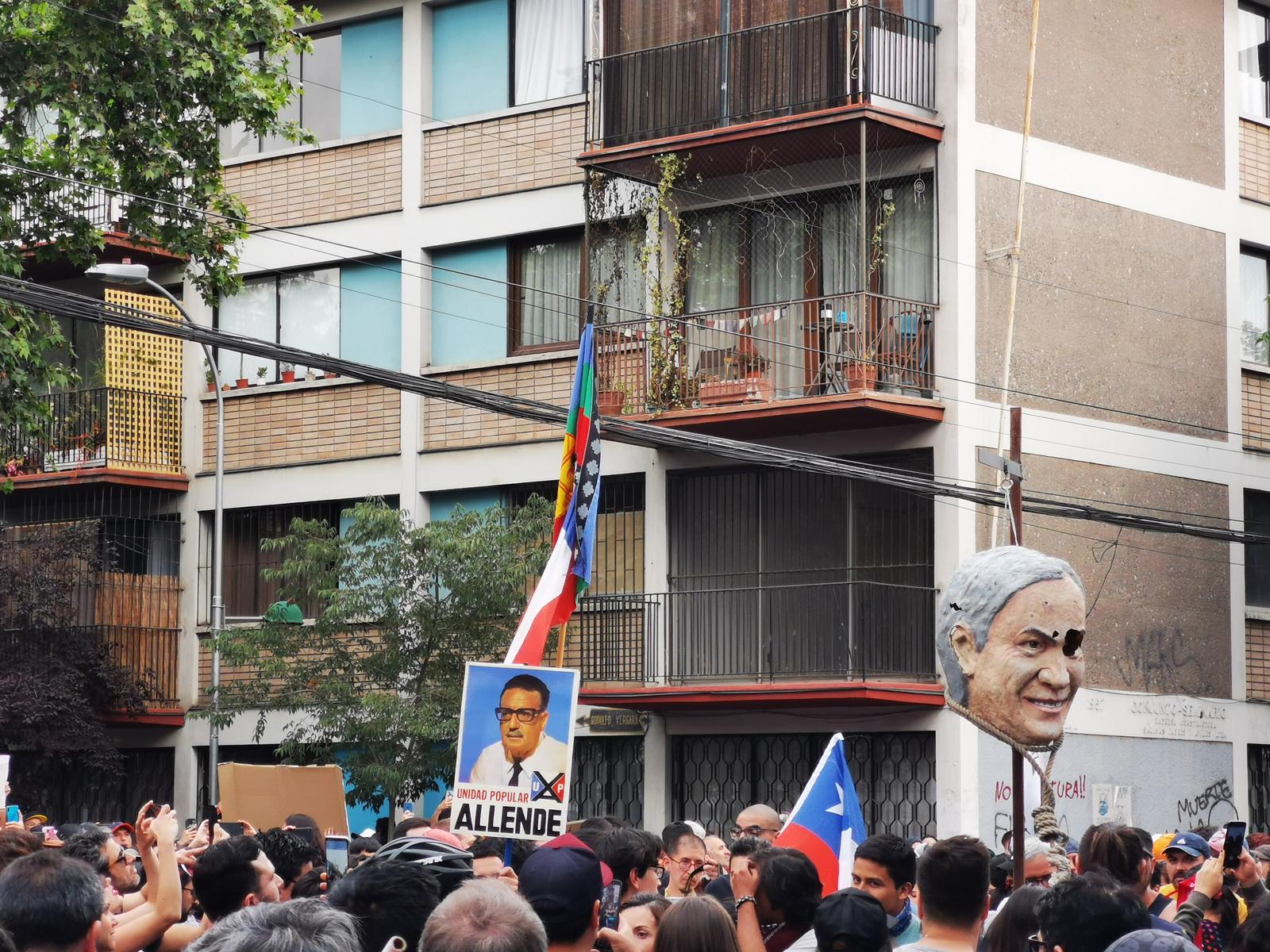
Lead photo. — Warko (CC BY-SA 4.0). Source: chile-protestas-nacionales.jpg

After the success of the initial 11 May 1983 protest, organising groups called monthly national protests; participation grew with each one as students and poor neighbourhoods (pobladores) joined the unions [source: nv-database]. Campaigners also used lightning protests — short, spontaneous actions that dispersed before police could arrive — and cacerolazos (neighbourhood pot-banging) that turned residential blocks into protest arenas [source: nv-database]. The army and security forces responded with violent repression; Pinochet used the existence of two armed resistance groups (Frente Patriótico Manuel Rodríguez and Movimiento de Izquierda Revolucionario) as justification for attacking nonviolent demonstrations and killing organisers [source: nv-database]. In response to the 1985 murder of three Communist Party members by security forces, the army occupied Santiago with soldiers and tanks [source: nv-database]. A National Workers’ Command-led strike coincided with the International Parliamentary Union assembly in Santiago in May 1986, drawing international attention to the repression [source: nv-database]. In July 1986 the Asamblea de la Civilidad (truckers, retailers, professionals) called several national strike days that became known as the jornadas [source: nv-database]. In 1987 Pinochet announced a national plebiscite; the opposition unified as Concertación de Partidos por el NO and on 5 October 1988 Chileans voted NO by nearly 55 percent, forcing democratic elections in 1989 [source: nv-database].
Key people & organizations
- Augusto Pinochet — dictator of Chile 1973–1990 [source: nv-database]
- Rodolfo Seguel — copper-workers’ union leader, head of the CTC [source: nv-database]
- Copper Workers’ Confederation (CTC) [source: nv-database]
- National Workers’ Command [source: nv-database]
- Asamblea de la Civilidad — truckers, retailers, professionals [source: nv-database]
- Concertación de Partidos por el NO — opposition coalition for the 1988 plebiscite [source: nv-database]
- Pobladores — residents of poor neighbourhoods who joined the protests after the first year [source: nv-database]
Outcome
Verdict: won.
The campaign achieved its goal: the Pinochet regime fell and Chile returned to democratic civilian rule [source: nv-database]. The organising groups survived through the 1988 plebiscite and the movement grew from small monthly protests to a national campaign that drew hundreds of thousands [source: nv-database]. Huneeus, in Civil Resistance & Power Politics, credits the sustained monthly mobilisations with eroding the regime’s legitimacy and triggering the 1988 plebiscite that produced Pinochet’s electoral defeat [source: nv-database].
Lessons
- A predictable, recurring national day of action (here, a monthly protest) is a low-cost tactic for sustaining momentum over years; opponents cannot endlessly mobilise repression against a routine that everyone knows is coming.
- Broad coalitions that start in the unions and expand to students, poor neighbourhoods, and professional associations widen the campaign’s legitimacy and reduce the regime’s ability to characterise it as a single class’s grievance.
- Complementary tactics (lightning protests, cacerolazos, protest strikes, national strike days) layer onto the monthly rhythm and give different segments of the coalition a role.
- Sustained mass mobilisation, not armed resistance, was the force that won; an attempted 1986 armed attack on Pinochet narrowed support for the nonviolent movement, illustrating how armed actions can undercut a dominant nonviolent strategy.
Sources
- Global Nonviolent Action Database — Chileans overthrow Pinochet regime, 1983-1988 —
nv-database - Huneeus, Carlos. “Political Mass Mobilization against Authoritarian Rule: Pinochet’s Chile, 1983-88.” in Civil Resistance & Power Politics: The Experience of Non-violent Action from Gandhi to the Present.
Disclaimer: Included as a teaching example of campaign craft, not as endorsement.
Sources & verification
nv-database— grounding: primary — license: link-only- Rewritten: 2026-06-25 via
worker_casestudies_v2.py; deepened 2026-07-10 against GNVAD pagechileans-overthrow-pinochet-regime-1983-1988(referenced in earlier sessions aschile-protestas-nacionales). - Verified by llm-qc on 2026-07-10.