
Where it took place
| Type | Place |
|---|---|
| Region | Latin America |
| Country | Chile |
Campaign at a glance
From 1983 to 1988, a broad coalition of trade unions, opposition political parties, and citizens in Chile used nonviolent protests, strikes, and a successful plebiscite campaign to force General Augusto Pinochet from power [source: nv-database]. The campaign began with a National Day of Protest in May 1983 and escalated through monthly demonstrations, lightning protests, and national strikes, despite severe state repression [source: nv-database]. In 1988, the opposition united to defeat Pinochet in a national plebiscite, leading to democratic elections and the end of his dictatorship in 1990 [source: nv-database].
Tactics used
- boycotts and strikes
- nonviolent direct action
- civil-resistance
- coalition building
- framing and narrative
- methods-of-nonviolent-action
Background
On September 11, 1973, a military coup led by General Augusto Pinochet overthrew democratically elected President Salvador Allende, establishing a repressive dictatorship [source: nv-database]. The regime used violence to suppress dissent, ‘disappeared’ thousands, and shifted the economy toward market policies, but an economic crisis in 1982-1983 sparked widespread opposition [source: nv-database]. The campaign’s goals were democratic elections, Pinochet’s resignation, and an end to human rights abuses and economic hardship [source: nv-database].
What happened
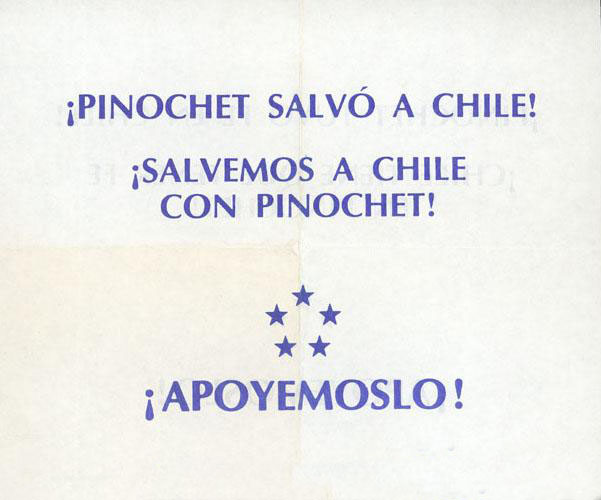
Lead photo. — Biblioteca del Congreso Nacional (CC BY 3.0 cl). Source: chileans-overthrow-pinochet-regime-1983-1988.jpg

On May 11, 1983, the Confederation of Copper Workers (CTC) called a National Day of Protest, with people in Santiago slowing activities and making noise at 8 PM; police arrested 600 and killed several protestors, but the action mobilized widespread dissent [source: nv-database]. Organizers then held monthly protests, with participation growing as students and poor Chileans joined, supported by opposition parties in the Democratic Alliance (formed August 1983) and the Catholic Church [source: nv-database]. Campaigners also used lightning protests—short, spontaneous actions that dispersed before police arrived [source: nv-database]. The regime responded with violent repression, using the army and security forces, and exploited the actions of armed groups (Frente Patriótico Manuel Rodríguez and Movimiento de Izquierda Revolucionaria) to justify attacks on peaceful demonstrators [source: nv-database]. In 1983 and 1984, the Democratic Alliance held two mass demonstrations with hundreds of thousands of participants [source: nv-database]. In 1985, after security forces murdered three Communist Party members, the archbishop of Santiago facilitated talks that led to the National Accord for the Transition to Full Democracy, but Pinochet rejected it [source: nv-database]. In May 1986, a National Workers’ Command-led strike coincided with the Assembly of the International Parliamentary Union in Santiago, drawing international attention [source: nv-database]. In July 1986, the Asamblea de la Civilidad called national strike days; on July 2, soldiers set two live demonstrators on fire [source: nv-database]. An armed attempt to assassinate Pinochet in September 1986 failed and limited support for the nonviolent campaign [source: nv-database]. In 1987, Pinochet announced a national plebiscite for 1988 on his continued rule, possibly due to international pressure, the Pope’s visit, or his belief he would win [source: nv-database]. The opposition formed the coalition concertación de partidos por el NO and used their allotted television time to broadcast hopeful messages and their rainbow ‘NO’ symbol [source: nv-database]. On October 5, 1988, nearly 55% voted NO; after hesitation, Pinochet stepped down when top military commanders refused to support him, and he left office on March 10, 1990 [source: nv-database].
Key people & organizations
- Confederation of Copper Workers (CTC)
- Rodolfo Seguel
- Democratic Alliance (Alianza Democratica)
- National Workers’ Command
- Asamblea de la Civilidad
- Catholic Church
- Augusto Pinochet
- Frente Patriótico Manuel Rodríguez
- Movimiento de Izquierda Revolucionario
- United Nations
- Pope John Paul II
Outcome
Verdict: won.
The campaign achieved its primary goal: Pinochet lost the 1988 plebiscite and was forced to hold democratic elections, which the opposition won by a landslide, beginning a transition to democracy. The organizing groups survived and grew, but Pinochet remained army chief until the mid-1990s, and the transition took many years [source: nv-database].
Lessons
- Sustained nonviolent protest can erode the legitimacy of a repressive regime, especially when combined with international pressure and elite defections.
- A unified opposition coalition with a clear message can effectively use limited legal openings, such as a plebiscite, to achieve democratic change.
- Armed resistance by separate groups can undermine nonviolent campaigns by providing the regime with a pretext for repression.
Sources
- Global Nonviolent Action Database —
nv-database
Disclaimer: Included as a teaching example of campaign craft, not as endorsement.
Sources & verification
nv-database— grounding: primary — license: link-only- Rewritten: 2026-07-04 via
worker_casestudies_v2.py