
Where it took place
| Type | Place |
|---|---|
| Region | Asia |
| Country | China |
Campaign at a glance
After being denied boarding on flights back to Shanghai four times in 2009 on Chinese government orders, Chinese human-rights activist Feng Zhenghu began a one-man occupation of Narita Airport near Tokyo on 4 November 2009, sleeping on a steel bench for 92 days and living off food donated by passersby. [source: nv-database] On 27 January 2010, two Chinese consular officials met him to negotiate; on 31 January they agreed that returning home is a citizen’s right, and on 12 February 2010 Feng successfully returned to Shanghai. [source: nv-database] He has been under house arrest in his Shanghai apartment since 27 February 2012, with supporters donating food via a basket lowered on a rope from his third-floor balcony. [source: nv-database]
Tactics used
Background
Feng Zhenghu openly supported the pro-democracy movement that ended in the 1989 Tiananmen Square crackdown; in the 1990s he studied and worked in Japan. [source: nv-database] Upon his return to Shanghai in 2000, the Shanghai government sentenced him to three years for “illegal business activities”; after prison he became a self-taught lawyer and rule-of-law advocate. [source: nv-database] Just before the 20th anniversary of the Tiananmen Square crackdown, the government pressured him to leave China, effectively forcing him into permanent exile. [source: nv-database]
What happened
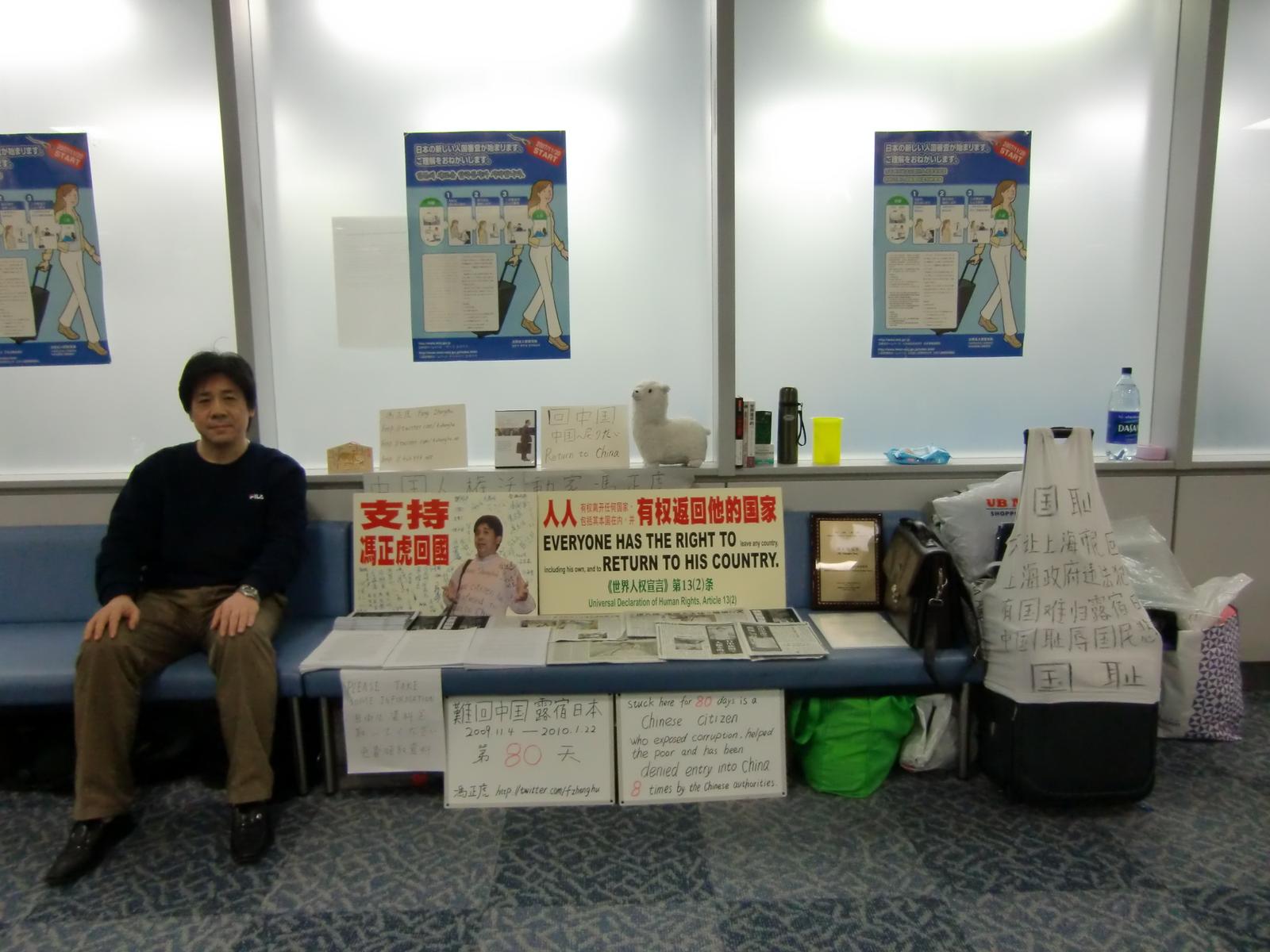
Lead photo. — zhenghu feng at Tokyo, Japan (CC BY 2.0). Source: chinese-activist-feng-zhenghu-occupies-tokyo-airport-ends-his-own-exile-china-2009-2010.jpg

Feng left China for Japan in April 2009 and attempted to return in June; on four occasions Japanese and US-based Northwest Airlines denied him boarding passes on Chinese government orders, and he was forcibly sent back to Tokyo each of the four times he reached Pudong Airport. [source: nv-database] After the fourth failed attempt, Feng began his one-man occupation on 4 November 2009 just before the Narita immigration checkpoint, with a handwritten sign reading “Stuck here is a Chinese citizen who exposed corruption, helped the poor and had been denied entry into China 8 times,” and T-shirts spelling out his predicament in English and Chinese. [source: nv-database] For 92 days he slept on a narrow steel bench, lived off food donated by passersby and supporters, and used a cell phone and laptop to blog and write Twitter posts set up by Chinese volunteers. [source: nv-database] Japanese airport officials refused to help him buy food past the checkpoint, but eventually allowed him to use his cell phone in a no-phone zone, designated a media-interview area, and chose not to force him out; some staff called him their friend. [source: nv-database] Supporters including airline crews visited with food and gifts, and over 5,000 Twitter followers began a donation fund. [source: nv-database] On 27 January 2010, two Chinese Embassy officials (Mr. Du and Consular Zhao) met Feng and offered three terms: no Shanghai government apology needed, re-entry approved but date undetermined, attendance at the International Expo in Shanghai dependent on his behaviour; Feng rejected all three. [source: nv-database] On 30 January, the officials returned and agreed that returning to one’s home country is a citizen’s right, ending the need to negotiate. [source: nv-database] On 31 January, Feng announced he would end his protest on 2 February 2010, and on 12 February 2010 he successfully returned to Shanghai. [source: nv-database] Since 27 February 2012, Feng has been under house arrest in his third-floor apartment; supporters donate food via a basket lowered on a rope from his balcony. [source: nv-database]
Key people & organizations
- Feng Zhenghu (Chinese human rights activist, self-taught lawyer)
- Chinese Embassy in Japan officials (Mr. Du, Consular Zhao)
- Shanghai government (opponent)
- Chinese government (opponent, denied boarding passes)
- Japanese airlines and Northwest Airlines (enforced Chinese government order)
- Japanese Narita airport officials (allowed occupation, called him a friend)
- Chinese volunteer Twitter account operators
- Airline crews and airport passersby (food and gift donors)
- International supporters (5,000+ Twitter followers)
Outcome
Verdict: won.
Feng Zhenghu successfully returned to Shanghai on 12 February 2010 after 92 days at Narita Airport. [source: nv-database] Per the source’s scoring rubric, the campaign scored 6 out of 6 points on achieving specific demands/goals, 1 out of 1 on survival, and 3 out of 3 on growth (10 out of 10 total). [source: nv-database] However, since 27 February 2012 Feng has been under house arrest, with his family barred from visiting and supporters supplying food via a balcony basket. [source: nv-database]
Lessons
- A single determined individual, sustained by digital amplification (Twitter, blog) and physical passersby, can hold a symbolic site for three months and force a foreign embassy to negotiate.
- Officials who reject your explicit terms may still concede the underlying principle (“returning home is a citizen’s right”); a long occupation can shift the venue from bargaining over conditions to affirming a baseline right.
- Winning re-entry does not equal freedom; the post-victory house arrest underscores the limits of an isolated, individual campaign against an authoritarian state.
Sources
- Global Nonviolent Action Database —
nv-database
Disclaimer: Included as a teaching example of campaign craft, not as endorsement.
Sources & verification
nv-database— grounding: primary — license: link-only- Rewritten: 2026-07-04 via
t6_build.py