
Where it took place
| Type | Place |
|---|---|
| Region | Asia |
| Country | China |
Campaign at a glance
In 1919, Chinese students in Beijing and across the country protested the Treaty of Versailles, which granted Japan control over Shantung Province [source: nv-database]. The campaign, known as the May Fourth Incident, involved student strikes, marches, and a general strike by workers and merchants. Ultimately, China refused to sign the treaty, though Japan retained control of Shantung.
Tactics used
- [boycotts-and-strikes
- nonviolent direct action
- civil-resistance
- coalition building
Background
After the Qing Dynasty fell in 1911, China was politically unstable with warlord rule [source: nv-database]. Japan’s 1915 Twenty-one Demands sought control over Shantung Province, fueling nationalist sentiment [source: nv-database]. At the 1919 Versailles Peace Conference, the decision to transfer Shantung to Japan instead of China sparked outrage among students and intellectuals [source: nv-database].
What happened
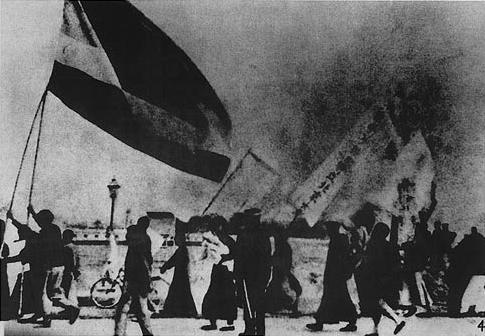
Lead photo. — Wikimedia Commons contributor (CC). Source: chinese-students-protest-the-treaty-of-versailles-the-may-fourth.jpg
On May 4, 1919, over 3,000 students from thirteen Beijing universities gathered at Tiananmen Gate to protest the Treaty of Versailles. [source: nv-database] They marched through the business district, issued pamphlets, and stormed a pro-Japanese official’s house, leading to clashes with police and arrests. [source: nv-database] The campaign spread to over 200 cities, with student strikes and marches. [source: nv-database] On June 5, Shanghai workers and merchants joined a general strike that shut down the city. [source: nv-database] The government arrested thousands of students but failed to suppress the movement. [source: nv-database] On June 28, Chinese students in Paris surrounded the Chinese delegation’s hotel, preventing them from signing the treaty. [source: nv-database] China refused to sign, and on July 22, the Student Union called off the strikes [source: nv-database].
Key people & organizations
- Student Union of Peking
- New People’s Study Society
- Young China Association
- New Tide Society
- Citizens Magazine Society
- Work-and-Study Society
- Common Voice Society
- Cooperative Study Society
- Union of Daily Newspapers in Shanghai
- Citizens’ Diplomatic Association
- Educational Association of Kiangsu Province
- Technical Research Society
- Association of European and American Returned Students
- Lawyers Association of Shanghai
- Chamber of Commerce of Peking
- Federation of Commercial Organizations of Shanghai
- Corps of Chinese Students in Japan for National Salvation
- Chu Ch’i-ch’ien
- Ch’en Tu-hsiu
Outcome
Verdict: partial.
China refused to sign the Treaty of Versailles, achieving a key goal, but Japan retained control of Shantung Province, so the outcome was partial. The campaign built cross-class solidarity and laid groundwork for future political change [source: nv-database].
Lessons
- Cross-class alliances between students, workers, and merchants can amplify pressure on a government.
- Sustained nonviolent action, including strikes and demonstrations, can force concessions even when repression is used.
- Coordinated action across multiple cities can create nationwide impact.
Sources
- Global Nonviolent Action Database —
nv-database
Disclaimer: Included as a teaching example of campaign craft, not as endorsement.
Sources & verification
nv-database— grounding: primary — license: link-only- Rewritten: 2026-06-25 via
worker_casestudies_v2.py