
Where it took place
| Type | Place |
|---|---|
| Region | North America |
| Country | United States |
Campaign at a glance
In 1968, Columbia University students, led by the Students for a Democratic Society and the Student Afro-American Society, protested the construction of a segregated gymnasium and the university’s affiliation with the Institute for Defense Analyses [source: nv-database]. The protests included sit-ins, building occupations, and a student strike, leading to police intervention and mass arrests. The campaign achieved partial success: the gymnasium plans were abandoned, a Black Studies program was created, and a University Senate was established, but some demands were not fully met [source: nv-database].
Tactics used
- unknown
Background
In 1959, Columbia University announced plans for a new gymnasium that would be segregated, with Harlem residents entering through a basement entrance and having limited access [source: nv-database]. That same year, Columbia joined the Institute for Defense Analyses (IDA), which students viewed as supporting the Vietnam War [source: nv-database]. In April 1967, President Grayson Kirk banned indoor demonstrations, and in March 1968, six SDS leaders were placed on probation for protesting IDA affiliation [source: nv-database].
What happened
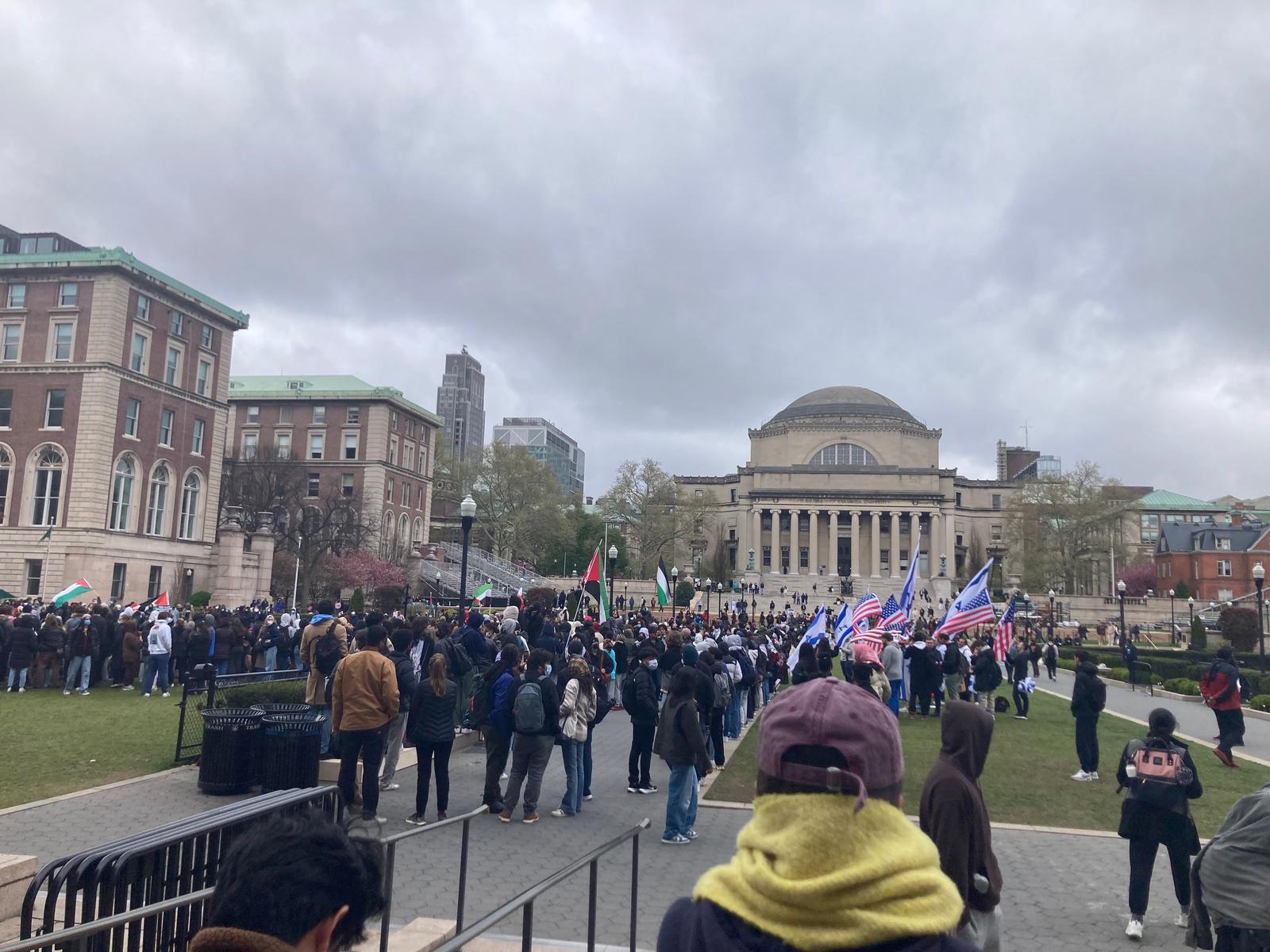
Lead photo. — Wikimedia Commons contributor (CC BY-SA 4.0). Source: columbia-university-students-protest-constructed-of-a-segregated.jpg

On 23 April 1968, SDS and SAS organized a rally of 300 people at Low Plaza Sun Dial, then marched to the gym construction site. [source: nv-database] Anti-demonstrators from the Majority Coalition blocked them from entering Low Library. [source: nv-database] Students began a sit-in at Hamilton Hall, restraining Dean Henry Coleman, and tore down fencing at the gym site; at least one demonstrator was arrested [source: nv-database]. The next day, 86 black SAS students evicted white SDS students from Hamilton Hall and renamed it ‘Malcolm X Liberation College’ [source: nv-database]. On 25 April, graduate students occupied Fayerweather Hall, and faculty formed an Ad-Hoc Faculty Group [source: nv-database]. On 26 April, Columbia temporarily suspended gym construction [source: nv-database]. On 30 April, New York City police cleared the campus, arresting 712 students and injuring 148 [source: nv-database]. Students formed a Strike Coordinating Committee and called for a student-faculty strike that lasted through the spring term [source: nv-database]. In March 1969, the University abandoned its plans for the gymnasium [source: nv-database]. The university also established a University Senate with 100 members, including students, faculty, and staff [source: nv-database].
Key people & organizations
- Students for a Democratic Society
- Student Afro-American Society
- Mark Rudd
- Cicero Wilson
- Grayson Kirk
- Henry Coleman
- David Truman
- Majority Coalition
- Ad-Hoc Faculty Group
- Strike Coordinating Committee
Outcome
Verdict: partial.
The campaign achieved three of six demands: the gym construction was cancelled, the university severed relations with IDA (though unclear), and disciplinary procedures were reformed. However, it is unclear whether the IDA-Six probation was lifted and whether all charges were dropped. The university also created a Black Studies program and a University Senate, indicating partial success. [source: nv-database]
Lessons
- Coalition-building between different student groups can amplify demands and broaden support.
- Sustained direct action and a strike can force institutional concessions even without full victory.
- Framing an issue as both a civil rights and anti-war concern can mobilize diverse constituencies.
Sources
- Global Nonviolent Action Database —
nv-database
Disclaimer: Included as a teaching example of campaign craft, not as endorsement.
Sources & verification
nv-database— grounding: primary — license: link-only- Rewritten: 2026-06-25 via
worker_casestudies_v2.py