
Where it took place
| Type | Place |
|---|---|
| Region | Asia |
| Country | Russia |
Campaign at a glance
On 19 August 1991, the “State Committee for the State of Emergency” — a group of hard-line Soviet officials — placed Mikhail Gorbachev under house arrest, shut down communication lines, and declared a six-month state of emergency. [source: nv-database] Boris Yeltsin arrived at the Russian parliament building (the “White House”) in Moscow, issued flyers declaring an “anti-constitutional coup,” and climbed atop a tank to denounce the coup. [source: nv-database] Over three days, tens of thousands of citizens built barricades in front of the White House, miners in Kuzbass and workers near Sverdlovsk struck, 200,000 rallied in Leningrad, and the head of the Army’s paratroops and commander of the Soviet Air Force refused to cooperate with the coup; the Committee disbanded its soldiers out of fear of disloyalty. [source: nv-database] The coup was defeated, Gorbachev returned to power, and 5 casualties were reported during the struggle. [source: nv-database]
Tactics used
- nonviolent direct action
- framing and narrative
- distributed organizing
- coalition building
- nonviolent-intervention
- strike
Background
Since assuming the role of General Secretary of the Communist Party in 1985, Mikhail Gorbachev had pushed for economic openness and political restructuring, prompting resistance from hard-line members of the Communist Party. [source: nv-database] Russia had declared its sovereignty in June 1990, beginning a period of constitutional reform, and by the early 1990s the Soviet Union was in economic and political crisis. [source: nv-database] In late 1990 a group of hard-line Soviet officials — including KGB Chairman Vladimir Kryuchkov, USSR Defense Minister Dmitriy Yazov, Internal Affairs Minister Boris Pugo, Prime Minister Valentin Pavlov, Vice President Gennady Yanayev, deputy Chief of the USSR Defence Council Oleg Baklanov, Gorbachev’s secretariat head Valeriy Boldin, CPSU Central Committee Secretary Oleg Shenin, and Deputy USSR Defense Minister General Valentin Varennikov — began conspiring against Gorbachev, hoping to stop the signing of a treaty that would further decentralize the Soviet Union. [source: nv-database]
What happened
Lead photo. — Bundesarchiv (CC BY-SA 3.0 de). Source: defense-soviet-state-against-coup-1991.jpg

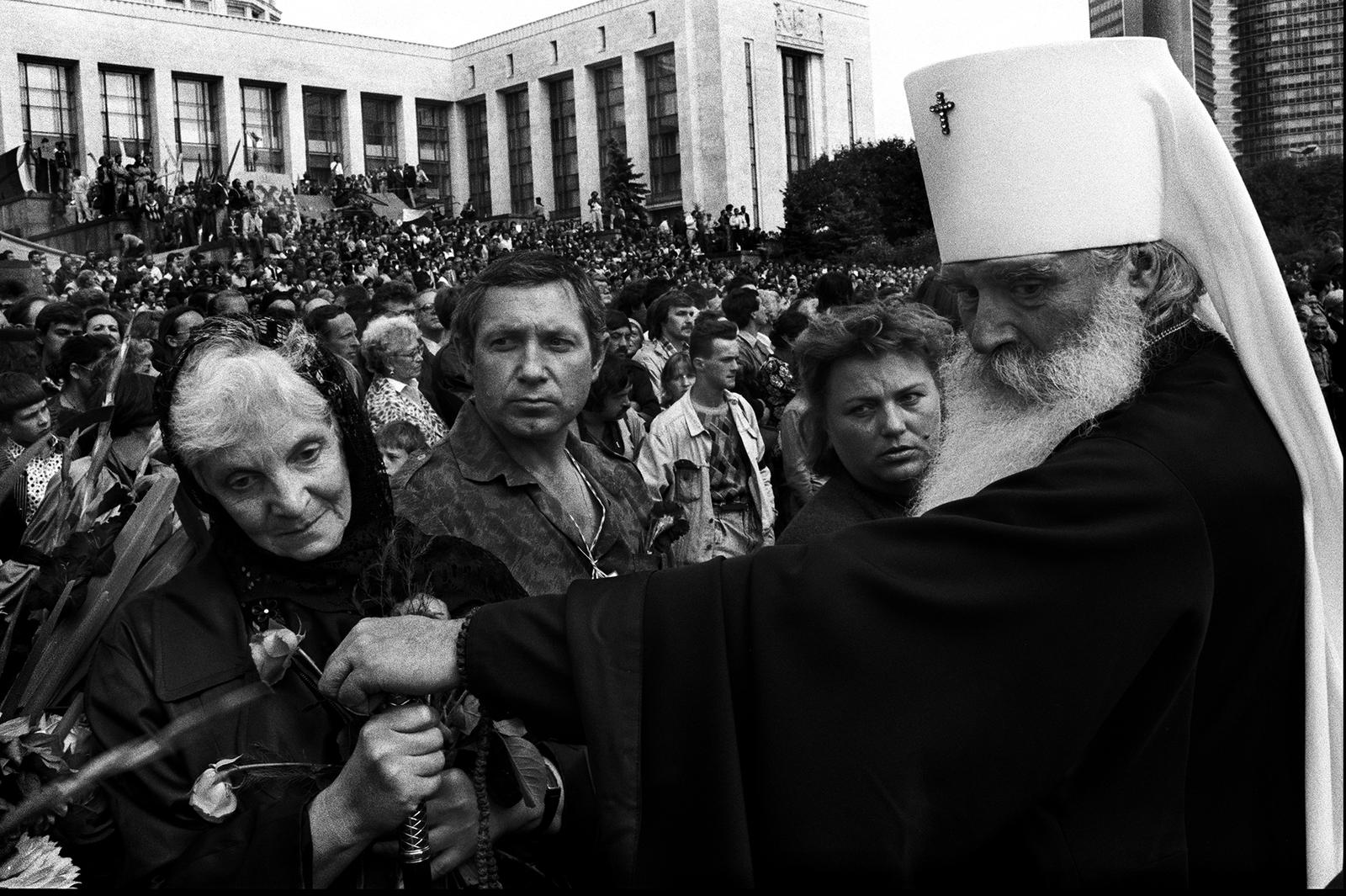
In early August 1991, Gorbachev went on holiday away from Moscow; on 18 August 1991, after a meeting with other co-conspirators in Moscow, Baklanov, Boldin, Shenin, and Varennikov flew to visit Gorbachev, demanding he either resign or declare a state of emergency and let the conspirators “restore order.” [source: nv-database] KGB security guards were called, Gorbachev was put under house arrest, communication lines were shut down, and the conspirators — referring to themselves as the “State Committee for the State of Emergency” — ordered hundreds of thousands of handcuffs and arrest forms to Moscow, doubled KGB salaries, emptied the Lefortovo prison, banned opposition newspapers, suspended opposition political parties, outlawed public demonstrations, and declared a six-month state of emergency. [source: nv-database] On 19 August 1991, the “Declaration of the Soviet Leadership” was broadcast by state radio and television, and armoured divisions of the military and paratroops entered Moscow. [source: nv-database] Soon after, Boris Yeltsin, newly elected President of the Russian Soviet Federative Socialist Republic, arrived at the Russian parliament (the “White House”), helped issue a flyer declaring an “anti-constitutional coup,” and urged the military not to cooperate, calling for a general strike demanding that Gorbachev address the people. [source: nv-database] In Moscow, tens of thousands of citizens gathered in the streets, many in front of the White House to protect it from a suspected attack, raising barricades from trolley cars and automobiles; some distributed printed lists of Gene Sharp’s 198 methods of nonviolent action, in Russian translation. [source: nv-database] Major Evdokimov, Chief of Staff of a tank battalion of an infantry division, declared his loyalty to the Russian SFSR; in a show of defiance, Boris Yeltsin climbed atop one of the military tanks to denounce the coup. [source: nv-database] The call for a general strike went largely unheeded, though miners in Kuzbass and other workers near Sverdlovsk did strike. [source: nv-database] The “Emergency Committee” announced a “special state of emergency,” and resistance organisers pasted leaflets calling for mass demonstrations the next day at the White House. [source: nv-database] By 20 August 1991, resistance to the coup had increased: in Leningrad 200,000 people rallied answering Mayor Anatoly Sobchak’s call to resist; tens of thousands blocked streets in Moldavia keeping Soviet troops at bay; leaders in Ukraine and Kazakhstan denounced the coup; demonstrations occurred in Minsk. [source: nv-database] In Moscow, banned newspapers secretly printed “The Common Paper” calling on citizens to resist; the banned radio station Echo Moscow defied the ban; Russian TV technicians distributed videotapes in twenty cities; and some state media officials refused to cooperate, allowing Yeltsin’s speeches to be broadcast on the evening news. [source: nv-database] On 20 August crowds remained at the White House in anticipation of a violent attack; demonstrators fraternised with the military, offering food and informational leaflets, while Yeltsin urged the crowds not to provoke the soldiers. [source: nv-database] On 21 August, a group of tanks was blocked in a tunnel by barricades of trolleybuses and street cleaning machines; by the afternoon three civilians (Dmitriy Komar, Vladimir Usov, and Ilya Krichevski) were dead, two from gunshot wounds, and a tank was set on fire by the crowd. [source: nv-database] The coup organisers attempted a final attack on the White House, but the head of the Army’s paratroops and the commander of the Soviet Air Force refused to cooperate, spoiling the plans; in some cases entire military units deserted, and ten tanks turned their turrets away from the parliament building. [source: nv-database] The “Emergency Committee” returned to Gorbachev, but he refused to meet with them; he then declared all orders and decisions of the Committee void and dismissed its members from their state offices. [source: nv-database] The next morning the Defense Board of the Soviet Union voted to withdraw the troops from Moscow; the conspirators and members of the “Emergency Committee” were arrested, and Gorbachev resumed leadership. [source: nv-database] On 24 August 1991 thousands attended the funeral of the three civilians in Moscow. [source: nv-database] The coup attempt contributed to the destabilisation of the Soviet Union and is considered to have led to the demise of the Communist Party and the Soviet Union itself: by the end of 1991 Gorbachev had resigned and the Soviet Union was officially dissolved. [source: nv-database]
Key people & organizations
- Boris Yeltsin (President of the Russian SFSR, climbed atop tank to denounce the coup)
- Mikhail Gorbachev (USSR President, placed under house arrest, then restored to power)
- Anatoly Sobchak (Mayor of Leningrad, called 200,000 to resist)
- Major Evdokimov (Chief of Staff of a tank battalion, declared loyalty to the Russian SFSR)
- Head of the Army’s paratroops and commander of the Soviet Air Force (refused to cooperate with the coup)
- “State Committee for the State of Emergency” (opponent; Kryuchkov, Yazov, Pugo, Pavlov, Yanayev, Baklanov, Boldin, Shenin, Varennikov)
- White House defenders (citizens, parliamentary staff)
- Kuzbass miners and Sverdlovsk-area workers (strikers)
- 200,000 Leningrad citizens (ralliers)
- Banned Moscow media (printed “The Common Paper”; Echo Moscow broadcasted)
- Lithuanian President Landsbergis (asked citizens to protect the Vilnius parliament)
- Ukrainian and Kazakh leaders (denounced the coup)
- Moldavian demonstrators (blocked streets against Soviet troops)
Outcome
Verdict: won.
The coup was defeated within three days: Gorbachev returned to power, the conspirators were arrested, the troops withdrew from Moscow, and the “State Committee for the State of Emergency” was dismissed. [source: nv-database] Five casualties were reported during the struggle (three in Moscow, plus additional reported deaths). [source: nv-database] Per the source’s scoring rubric, the campaign scored 6 out of 6 points on achieving specific demands/goals, 1 out of 1 on survival, and 3 out of 3 on growth (10 out of 10 total). [source: nv-database] The campaign nonetheless contributed to the destabilisation of the Soviet Union: by the end of 1991 Gorbachev had resigned and the Soviet Union was officially dissolved. [source: nv-database]
Lessons
- Defending a single symbolic building (the White House) concentrates the resistance and the cost of an attack for the plotters; a small, persistent occupation can be a strategic anchor.
- Fraternisation with security forces (offering food, leaflets, and direct conversation) is more decisive than mass confrontation when the plotters depend on military loyalty.
- Banning media does not silence it: secret newspapers, distributed videotapes, and defiant radio stations can keep the public informed and connected across many cities in a matter of hours.
- A defeated coup can still destroy the regime it tried to save: winning the battle did not save the Soviet Union, but it shifted political authority decisively toward the resistance.
Sources
- Global Nonviolent Action Database —
nv-database
Disclaimer: Included as a teaching example of campaign craft, not as endorsement.
Sources & verification
nv-database— grounding: primary — license: link-only- Rewritten: 2026-07-04 via
t6_build.py
Learn more
- On Wikipedia: 1991 Soviet coup attempt — CC BY-SA 4.0