
Where it took place
| Type | Place |
|---|---|
| Region | Latin America |
| Country | Ecuador |
Campaign at a glance
In 1994, Ecuadorian Indigenous organizations led by CONAIE mobilized against proposed neoliberal reforms to the Agrarian Law that would privatize water and land [source: nv-database]. The campaign included occupations, roadblocks, and a national uprising called Movilización por la Vida. Although the law was not repealed, the government made concessions including public ownership of water and inclusion of Indigenous representatives on a state agency.
Tactics used
- nonviolent direct action
- civil-resistance
- coalition building
- petitions and e campaigning
- methods-of-nonviolent-action
Background
Since Ecuador’s founding, economic policy oppressed Indigenous citizens by concentrating and destroying their lands. In 1994, President Sixto Durán Ballén proposed neoliberal reforms to the Agrarian Reform Law that would privatize water and land, end agrarian reform, and increase colonization of Indigenous territories [source: nv-database]. CONAIE, founded in 1986 by Luis Macas, led the opposition to protect Indigenous land and water rights [source: nv-database].
What happened
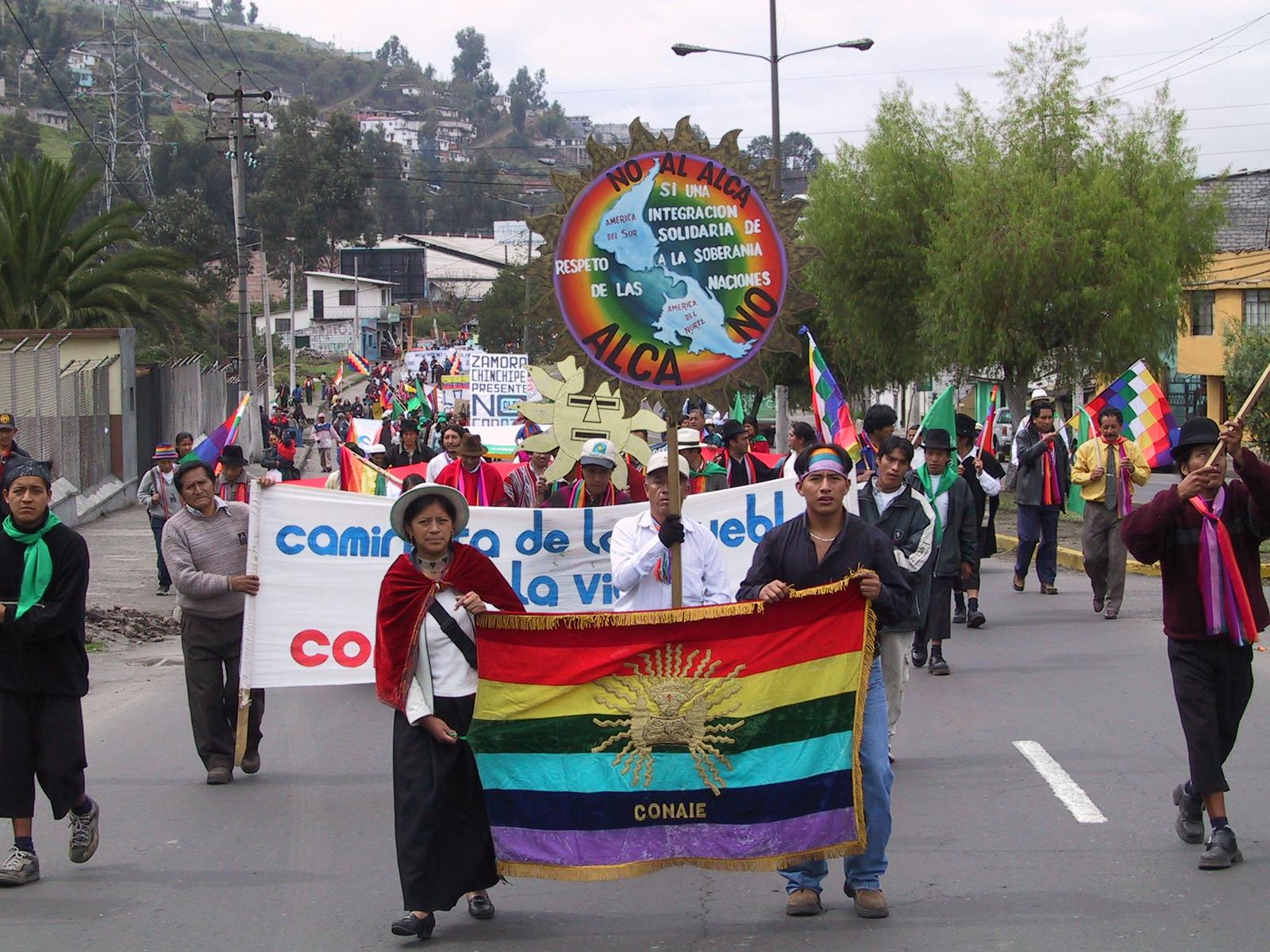
Lead photo. — Donovan & Scott (CC BY-SA 4.0). Source: ecuadorian-indigenous-stage-mass-uprising-against-neo-liberal-measures-including-privatizing.jpg

On 24 January 1994, CONAIE, CONFENIAE, OPIP, and Acción Ecológica occupied the offices of the Minister of Energy and Mines in Quito, with about 150 activists forming a human chain and picketing outside. [source: nv-database] After five hours, the minister met with protesters and agreed to a meeting between OPIP and ARCO, and to form a commission on petroleum development [source: nv-database]. On 4 May 1994, President Ballén presented the Ley Ordenamiento del Sector Agrario to Congress as an urgent matter. [source: nv-database] CONAIE printed slogans and Macas spoke against the law, threatening national protest if it passed [source: nv-database]. On 18 May the Plenary of Legislative Commissions rejected the president’s law, but on 27 May the PSC proposed an almost identical law, which passed on 3 June 1994 [source: nv-database]. CONAIE held a national assembly on 7-8 June and launched the Movilización por la Vida, publishing the Riobamba Mandate demanding a presidential veto, a moratorium on oil concessions, repeal of petroleum price increases, and cancellation of BNF loans [source: nv-database]. On 12 June, roadblocks began at five strategic locations in Pastaza, spreading nationwide; by 13 June all major roadways between provinces were blocked. [source: nv-database] Demonstrators allowed people to walk through but no vehicles [source: nv-database]. On 17 June, CONAIE secured a meeting with President Ballén for 21 June. [source: nv-database] On 20 June, the BNF signed an agreement to pardon outstanding interest and stop coercive arbitration [source: nv-database]. The meeting on 21 June failed to reach agreement; that night the president declared a state of emergency, giving the military power to ensure order. [source: nv-database] By 30 June, Abya Yala News reported 15 Indigenous activist deaths from military intervention [source: nv-database]. CONAIE called for an end to military actions and formation of a mediation commission; the president agreed and negotiations ran from 30 June to mid-July [source: nv-database]. A reformed version of the law went into effect on 3 August 1994, but the government made concessions: maintenance of cooperative small agrarian organizations, inclusion of two Indigenous representatives on a state agency, and public ownership of water [source: nv-database]. The petroleum commission formed on 24 September 1994 but discussions did not lead to clear results [source: nv-database].
Key people & organizations
- Confederation of Indigenous Nationalities of Ecuador (CONAIE)
- Luis Macas
- Organization of Indigenous Peoples of Pastaza (OPIP)
- Confederation of Indigenous Nationalities of the Ecuadorian Amazon (CONFENIAE)
- Acción Ecológica
- President Sixto Durán Ballén
- Ecuadorian National Congress
Outcome
Verdict: partial.
The campaign achieved 2 out of 6 specific demands: the cancellation of BNF loans and some concessions on water and representation, but the main goal of blocking the Agrarian Development Law failed as a reformed version passed. The movement demonstrated significant growth and strength, contributing to the ongoing struggle for Indigenous rights. [source: nv-database]
Lessons
- National roadblocks can effectively disrupt economic activity and force government negotiations.
- Coalition-building across Indigenous organizations and environmental groups amplifies pressure.
- Combining direct action with political negotiation can yield partial concessions even when the main demand is not met.
Sources
- Global Nonviolent Action Database —
nv-database
Disclaimer: Included as a teaching example of campaign craft, not as endorsement.
Sources & verification
nv-database— grounding: primary — license: link-only- Rewritten: 2026-07-04 via
worker_casestudies_v2.py