
Where it took place
| Type | Place |
|---|---|
| Region | Latin America |
| Country | El Salvador |
Campaign at a glance
In February 1921, the guild of San Salvador’s Zapateros (shoemakers) timed a Holy Week strike to coincide with the seasonal demand for new shoes, denying retailers their Easter stock and forcing shop owners to concede higher wages, an end to arbitrary dismissals, and fair treatment of employees. [source: nv-database] The campaign scored 9 of 10 on the source’s rubric — full marks on demand achievement. The strike also planted the seed for what became the Alianza Nacional de Zapateros a decade later. [source: nv-database]
Tactics used
- strike
- nonviolent direct action
Background
Before 1919, labor unions were virtually nonexistent in El Salvador, and even as they formed they were not officially recognized by the government until 1923 and 1924. [source: nv-database] Working under the Meléndez-Quiñónez regime, which ruled from 1913 to 1931, organizing was dangerous; labor movements came in waves, with multiple craft guilds acting in parallel.
The Zapateros guild first drew up a list of grievances — low wages, hunger, mass unjustified dismissals, personal abuse and mistreatment — and from those grievances developed three core demands: higher wages, an end to arbitrary dismissals, and fair treatment. [source: nv-database]
What happened
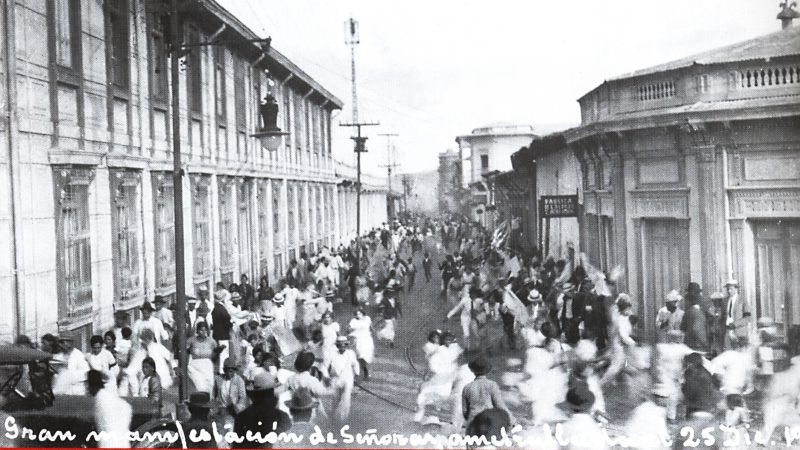
Lead photo. — Unknown authorUnknown author (Public domain). Source: el-salvador-shoemakers-win-strike-higher-wages-1921.jpg

The strike opened during the Catholic celebration of Holy Week, when retailers traditionally displayed their best merchandise to attract shoppers buying shoes for Easter. [source: nv-database] Without the Zapateros’ production, shop owners had no Easter stock to sell.
On February 28 the strike ended with the strikers walking away from negotiations having won all three demands. [source: nv-database]
After 1931, Miguel Mármol, who at age sixteen had assisted in organizing the Zapateros strike, became president of the Alianza Nacional de Zapateros (National Alliance of Shoemakers), which expanded the guild to a national level. [source: nv-database]
Key people & organizations
- Gumercindo Ramírez — strike leader
- Miguel Mármol — sixteen-year-old organizer who went on to head the Alianza Nacional de Zapateros a decade later
- The guild of Zapateros (shoemakers) of San Salvador — the striking organization
- The Meléndez-Quiñónez regime — the political backdrop
Outcome
Verdict: won.
The campaign scored 6 of 6 on achieving demands — wages rose, arbitrary dismissals ended, and employees received fair treatment. [source: nv-database] The guild’s infrastructure outlived the strike itself, with the National Alliance of Shoemakers founded a decade later under Mármol’s leadership.
Lessons
- Timing a strike to coincide with the buyer’s peak need can shrink a year-long industrial dispute into a single week.
- Even a one-week strike can plant the seeds for a national union if younger participants are drawn into leadership.
- When formal bargaining channels do not exist, illegal direct action can substitute — but it must still end with concrete, winnable demands.
Sources
- Global Nonviolent Action Database — El Salvador Shoemakers win strike for higher wages, 1921 —
nv-database
Disclaimer: Included as a teaching example of campaign craft, not as endorsement.
Sources & verification
nv-database— grounding: primary — license: link-only / all-rights-reserved (ND-style; content paraphrased, not quoted)- Verified: 2026-07-04 by human