
Where it took place
| Type | Place |
|---|---|
| Region | Africa |
| Country | Guinea |
Campaign at a glance
Since gaining independence from France in 1958, autocratic rulers have controlled Guinea and made it one of the poorest countries in the world despite the fact that the country is rich in aluminum. The first ruler, Ahmed Sékou Touré, held office for almost 30 years until his death. Lansansa Conté seized power through a coup d’état after this and maintained his rule until 2008 when he also died. Then, Moussa “Dadis” Camara seized control of the government through another coup d’état on December 23, 2008. Though the government remained fairly stable throughout this time, it only did so through v. [source: nv-database]
Tactics used
- protest-meetings
- public-speeches
- hunger-strike
- declarations-of-indictment-and-intention
- general-strike
- boycotts and strikes
Background
This violent repression received international attention on September 28, 2009 when the junta ordered soldiers to end protests that were taking place in a stadium in the capital of Conakry. Although reported numbers vary, it is estimated that at least 50,000 pro-democracy protesters were in the stadium holding a peaceful rally. The soldiers attacked the protesters, killing 157 people and wounding 1,200 more. Additionally, news sources and civilians reported that the soldiers seized dozens of women and drove them to nearby villas where they gang-raped them for several days. [source: nv-database]
What happened
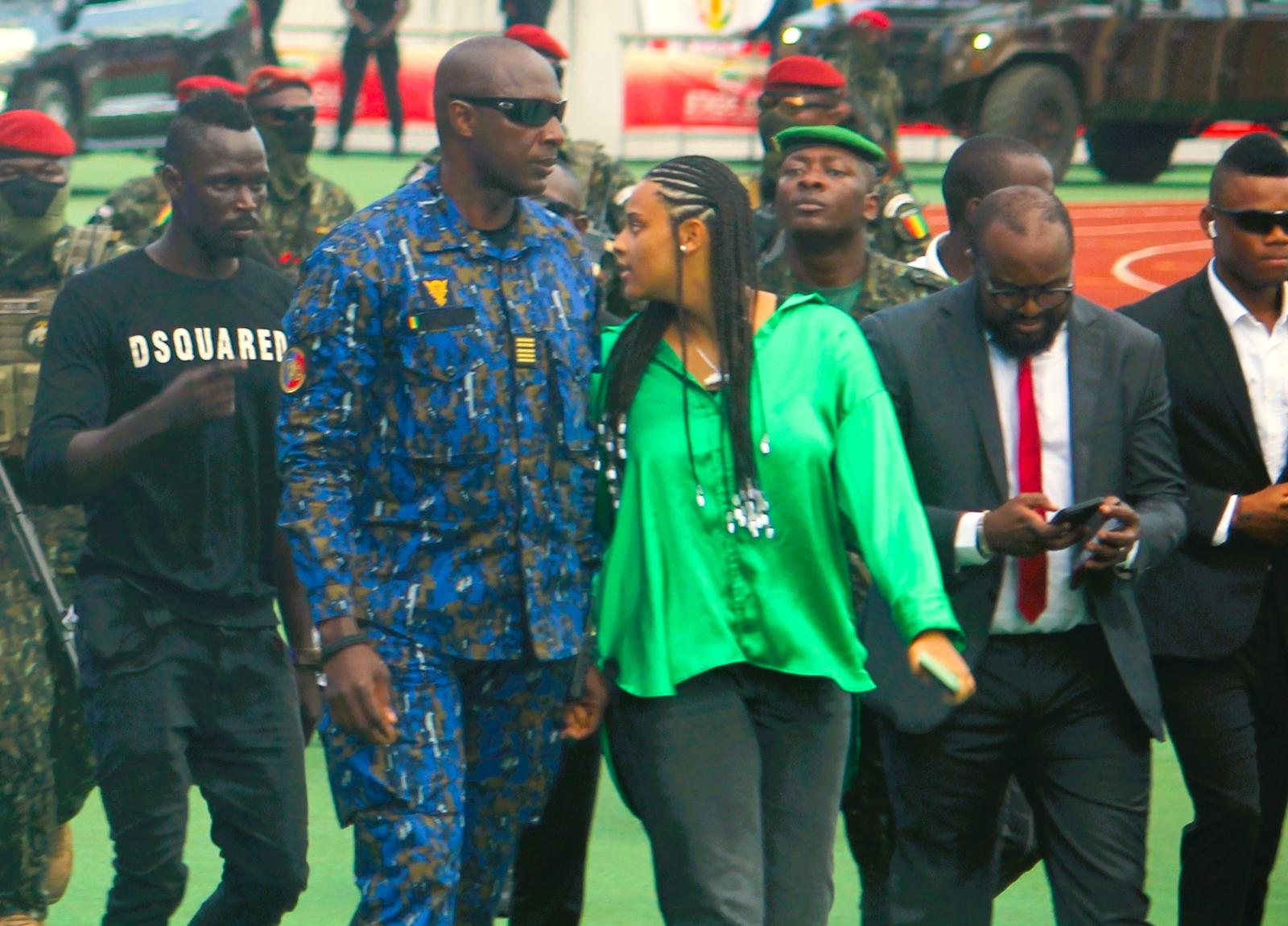
Lead photo. — Aboubacarkhoraa (CC BY-SA 4.0). Source: guineans-campaign-against-government-repression-2009.jpg

The government quickly denied any wrongdoing, saying that only 57 were killed and that most were trampled to death by other protesters trying to escape. They also blamed uncontrollable military factions for the rapes. However, the international community would not accept this excuse. Within days, the United States, the European Union, and the Economic Community of West African States placed arms embargoes on Guinea, froze the government’s assets, or restricted travel to and from the country. Additionally, the people of Guinea began organizing symbolic protests of remembrance to mourn those killed by the government. Members of the opposition organized a daylong general strike throughout Guinea planned for October 28, 2009 (exactly one month after the massacre) to send a message to the government that the people wanted justice and that the government would have to open a dialogue with them. Simultaneously, students from the Federation of Youth Associations of Guinea were organizing students across the country to take part in the strikes while also preparing to go on a five-day hunger strike. The government deemed both the general strike and the hunger strike illegal. The government had already allowed two days in the beginning of October as a time for mourning and thus considered the general strike to be illegitimate. Additionally, the government considered engaging in a hunger strike to be illegal regardless of the circumstances. Despite this, twelve students announced their intention to participate in the hunger strike and began on October 28. The general strike closed down most of the businesses, shops, and government offices in the capital city. Contrary to strikes in the past, the leaders of the strike asked that people stay in their houses instead of gathering in the streets to protest. The organizers did this out of fear that public protests would only result in another massacre like that of September 28. A member of the opposition who was organizing the strike estimated that out of 97,000 government workers, only 3,000 reported to work on the day of the general strike. Overall, the leaders considered this extremely successful, but followed their initial plans to limit the strike to only one day. On the other hand, the twelve students were not as immediately successful in their hunger strike. After only a day, government soldiers arrested the students, . [source: nv-database]
Key people & organizations
- Federation of Youth Associations of Guinea [source: nv-database]
- Opposition Members [source: nv-database]
- Students [source: nv-database]
- workers [source: nv-database]
- union members [source: nv-database]
- pro-democracy demonstrators [source: nv-database]
- women [source: nv-database]
Outcome
Verdict: partial.
Per the source’s scoring rubric, the campaign scored 1 out of 6 points on achieving specific demands/goals, 1 out of 1 points on survival, and 3 out of 3 points on growth — for 5 out of 10 points overall. [source: nv-database]
Although President Camara has abdicated his position after a failed assassination attempt and promised fair, peaceful elections, there is no reason to believe that this campaign had any direct correlation to this event. However, the students were able to open a direct line of communication to high-level officials in the government and begin to engage in dialogue. The protests were designated to be only a certain length of time (one day for the general strike and five days for the hunger strike) and maintained large numbers throughout this time (possibly as many as 94,000 out of 97,000 government workers striking). [source: nv-database]
Lessons
- A campaign can survive and grow even when its core demands are not met — sustaining an organization matters as much as immediate wins.
- Although President Camara has abdicated his position after a failed assassination attempt and promised fair, peaceful elections, there is no reason to believe that this campaign had any direct correlation to this event. [source: nv-database]
- Economic pressure through strikes remains a core lever for labor and pro-democracy campaigns in West Africa.
Sources
- Global Nonviolent Action Database —
nv-database
Disclaimer: Included as a teaching example of campaign craft, not as endorsement.
Sources & verification
nv-database— grounding: primary — license: link-only- Built: 2026-07-04 from GNVAD content via T1 balance pipeline.