
Where it took place
| Type | Place |
|---|---|
| Region | Latin America |
| Country | Honduras |
Campaign at a glance
From June 28, 2009 through 2011, the National Front of Popular Resistance (FNRP) sustained highway blockades, embassy sit-ins, mass marches of up to 500,000, and an international campaign that isolated Honduras from the OAS, but failed to win the reinstatement of the deposed President Manuel Zelaya. [source: nv-database] The November 2009 election of Porfirio Lobo Sosa installed a post-coup government that, despite a Truth and Reconciliation Commission, suffered at least fifty paramilitary-style assassinations of opposition activists, over 3,000 illegal detentions, and thousands of human-rights abuses. The source scores the campaign as a loss on its primary demand but credits the FNRP with preventing the international community from normalizing the post-coup regime. [source: nv-database]
Tactics used
- marches
- nonviolent direct action
- declarations-by-organizations-and-institutions
- civil-resistance
- international-solidarity
Background
Honduras’s 1982 constitution did not provide structures for popular democratic participation. [source: nv-database] In June 2009, President Manuel Zelaya called for a referendum on whether a constituent assembly should rewrite the constitution. Elected in 2005 as a cattle-rancher conservative, Zelaya had since moved left and allied himself with Venezuelan President Hugo Chávez; he maintained that he wanted to guarantee wider and fairer representation to all Hondurans. [source: nv-database]
The Supreme Court, Parliament, and military feared Zelaya would change the constitution to allow presidents to seek re-election beyond a single four-year term. When armed forces chief General Romeo Vásquez opposed the referendum, Zelaya attempted to fire him on June 24, 2009. The Supreme Court ordered Zelaya to reinstate Vásquez; he did not do so. [source: nv-database]
What happened
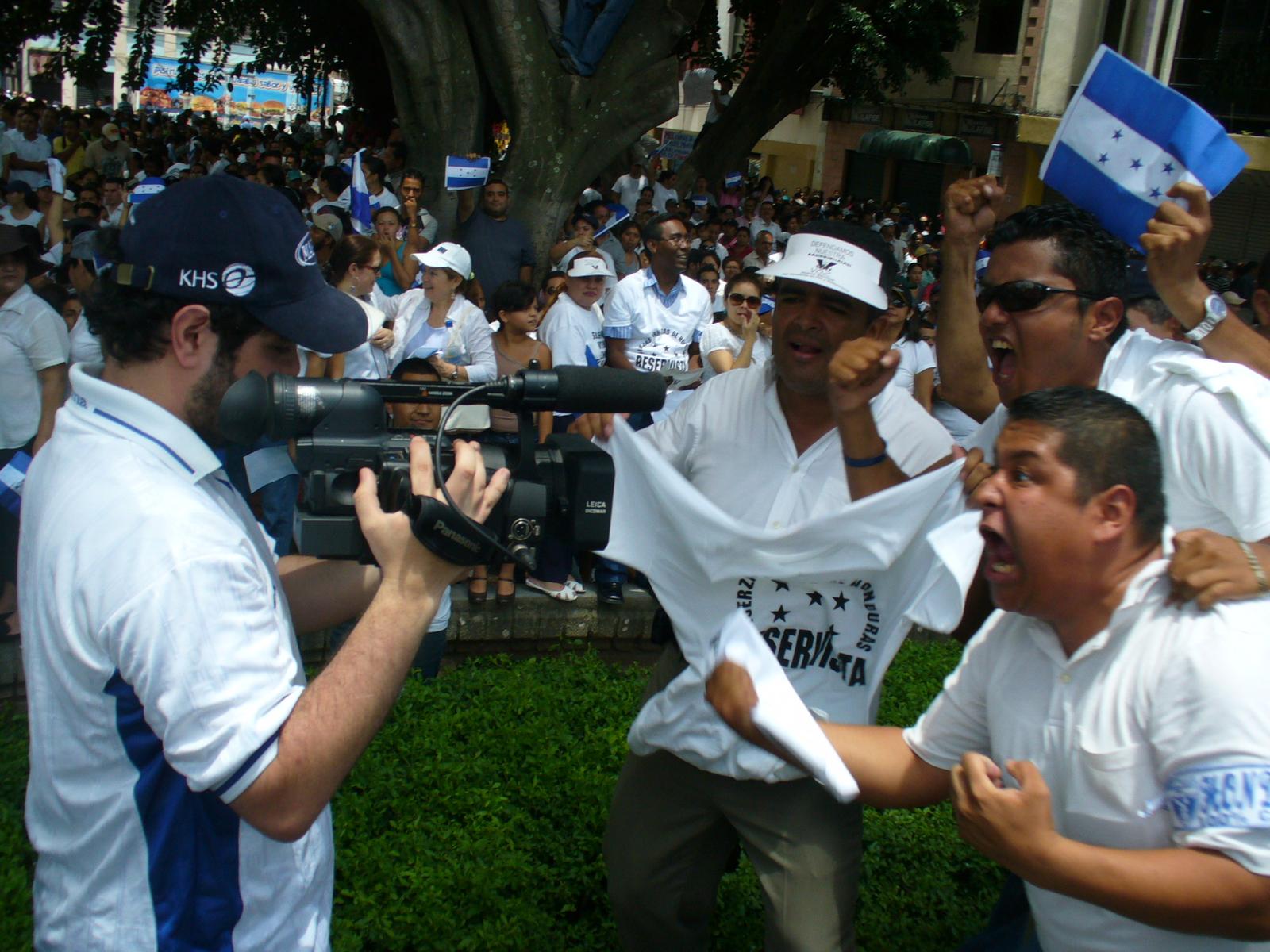
Lead photo. — enrique galeano morales (CC BY 2.0). Source: hondurans-campaign-return-former-president-zelaya-2009-2011.jpg

On June 28, over 200 military officers broke into Zelaya’s home, beat him, tied him down, and put him on a plane to Costa Rica. Congress swore in Roberto Micheletti as president hours later, claiming to read a letter of resignation from Zelaya — which he denied writing. [source: nv-database]
Zelaya’s presidency minister Enrique Flores Lanza announced a campaign of civil resistance. On the same day, thousands of Hondurans protested in the streets and called for Zelaya’s return. Police used tear gas, beat and arrested protesters, and killed at least twenty (per the July 2011 Truth Commission report). Interim President Micheletti suspended civil liberties, shut down opposition media, and declared a two-day curfew. [source: nv-database]
The United States, the European Union, the OAS, and ALBA all condemned the coup. On July 1, 2009, the United States suspended joint military operations with Honduras. OAS Secretary-General José Miguel Insulza gave Honduras an ultimatum: allow Zelaya safe return by July 4 or face expulsion. Micheletti refused. On July 4, Honduras was expelled from the OAS. [source: nv-database]
US Secretary of State Hillary Clinton asked Costa Rican President Oscar Arias to mediate in July 2009. Arias proposed Zelaya’s reinstatement with an all-party government and international supervision, fresh elections, abandonment of the constituent-assembly push, and amnesty for all involved. Both parties resisted; the talks failed. [source: nv-database]
Zelaya was popular among the poor. Across Honduras, women, trade unions, campesinos, gay and lesbian groups, indigenous organizations, Afro-Hondurans, teachers, students, and human-rights groups formed a grassroots coalition — La Frente Nacional de Resistencia Popular (FNRP) — for participatory democracy and a constituent assembly. [source: nv-database]
On July 16, 2009, FNRP members, dressed in red shirts and scarves, blockaded the northern and southern entrances to Tegucigalpa and blocked roads in Comayagua and Copán. On September 21, 2009, Zelaya returned to Honduras and took refuge in the Brazilian Embassy; thousands rallied around the embassy to demand his return to office. [source: nv-database]
In November 2009, Porfirio Lobo of the National Party was elected president. Zelaya supporters boycotted the vote: official turnout was 62%, but independent estimates put turnout at 47%. In January 2010, Zelaya agreed to go into exile in the Dominican Republic to avoid prosecution. With US President Barack Obama’s support, Lobo tried to create an image of national reconciliation but received no support from the opposition or the oligarchs who had backed the coup. [source: nv-database]
In May 2010, Lobo set up a Truth and Reconciliation Commission; the resistance discredited it for lacking enforcement power and for looking only at abuses before Lobo’s presidency. The Supreme Court defied Lobo and fired five judges and public defenders who opposed the coup. Soon after the coup and through Lobo’s presidency, the FNRP documented at least fifty paramilitary-style assassinations of opposition activists, over 3,000 illegal detentions, and thousands of human-rights-abuse reports. [source: nv-database]
On May 1, 2010, 500,000 marched in Tegucigalpa to [continue opposition]. [source: nv-database]
Key people & organizations
- Manuel Zelaya — the elected president exiled in the June 28, 2009 coup
- General Romeo Vásquez — armed forces chief who triggered the constitutional confrontation
- Roberto Micheletti — the interim president installed after the coup
- Porfirio Lobo Sosa — the National Party president elected in November 2009
- Enrique Flores Lanza — Zelaya’s presidency minister who launched the campaign of civil resistance
- The Frente Nacional de Resistencia Popular (FNRP) — the broad coalition of women, unions, campesinos, LGBTQ+, indigenous, Afro-Honduran, students, and human-rights groups
- The Brazilian Embassy in Tegucigalpa — shelter for Zelaya’s return in September 2009
- Oscar Arias — Costa Rican mediator
- José Miguel Insulza — OAS Secretary-General
Outcome
Verdict: lost.
Zelaya was not reinstated and lived in exile until the 2011 Cartagena Agreement facilitated his return to Honduras (without resuming the presidency). [source: nv-database] Lobo’s government installed a partial Truth Commission but did not face accountability, and the documented killings, detentions, and human-rights abuses continued. The source notes that the campaign prevented the international community from normalizing the post-coup regime but did not achieve its central demand.
Lessons
- A coup can be met with multi-class civil resistance that survives for years if the coalition’s frame (here, “participatory democracy and a constituent assembly”) is broader than the single issue (Zelaya’s reinstatement).
- International isolation (OAS expulsion, US suspension of operations) is a powerful pressure tool but insufficient on its own when the post-coup regime has internal military backing.
- A boycott election can deny legitimacy to the post-coup government but cannot, on its own, undo the institutional changes the coup installed.
Sources
- Global Nonviolent Action Database — Hondurans campaign for the return of former President Zelaya, 2009-2011 —
nv-database
Disclaimer: Included as a teaching example of campaign craft, not as endorsement.
Sources & verification
nv-database— grounding: primary — license: link-only / all-rights-reserved (ND-style; content paraphrased, not quoted)- Verified: 2026-07-04 by human