
Where it took place
| Type | Place |
|---|---|
| Region | Asia |
| Country | Hong Kong |
Campaign at a glance
On 29 July 2012, the Hong Kong government announced that by 2015 it would introduce mandatory “national education” classes in public schools, featuring a “China Model” textbook that described the Communist Party as “progressive, selfless, and united” and glossed over the Tiananmen and Cultural Revolution events. [source: nv-database] Roughly 90,000 people marched from Victoria Park to government headquarters, and three students began a three-day hunger strike on 30 August; on 8 September Chief Executive Leung Chun-ying revoked the 2015 deadline, allowing each school to decide whether to teach the subject. [source: nv-database] Although the government refused to cancel the curriculum outright, the campaign won an indefinite halt to the rollout. [source: nv-database]
Tactics used
- nonviolent direct action
- framing and narrative
- coalition building
- hunger-strike
Background
Hong Kong’s 2012 proposal would not have affected international schools (used mostly by wealthier families) but would have applied to all public schools, drawing the opposition of students, teachers, and parents who saw it as “brainwashing” and a step toward integrating Hong Kong into the Communist mainland. [source: nv-database] The proposed textbook “The China Model” described the Communist Party as “progressive, selfless, and united,” criticised multiparty systems, and glossed over the Tiananmen Protests and the Cultural Revolution. [source: nv-database] The campaign was inspired by the 1989 Tiananmen protests, and organisers explicitly drew on the “Occupy” movement’s tactics of persistent return to the protest site. [source: nv-database]
What happened
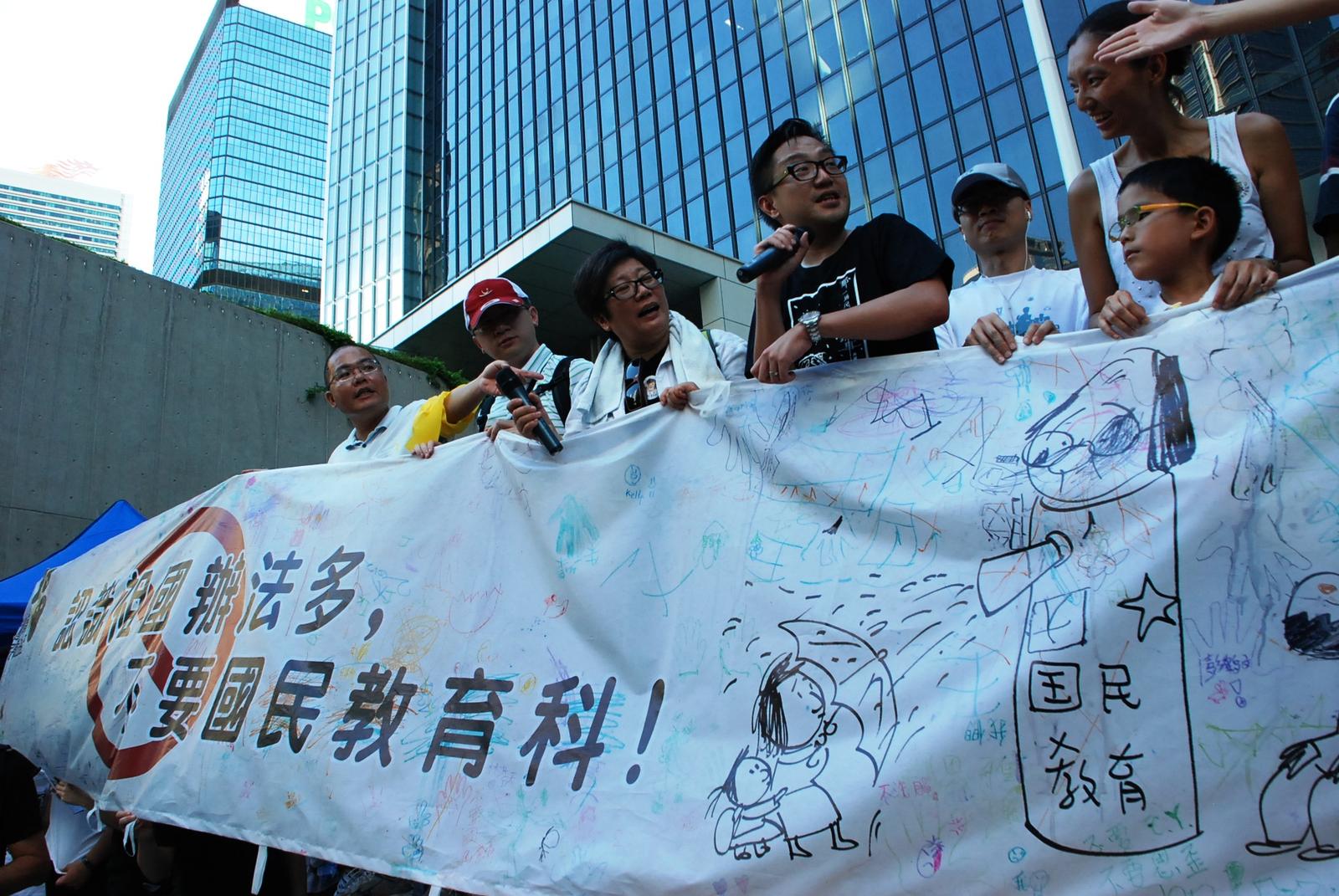
Lead photo. — Iris Tong (Public domain). Source: hong-kong-students-and-residents-reject-national-education-classes-2012.jpg

On 29 July 2012, roughly 90,000 people marched from Victoria Park to government headquarters, blocking parts of Causeway Bay, with banners and the chant “No thought control! Preserve one country, two systems!” [source: nv-database] On 30 August, three students started a three-day hunger strike demanding removal of the curriculum; the next day 70 parents, students, and educators met at Holy Cross Church. [source: nv-database] The Hong Kong Professional Teachers’ Union, with 90,000 members, planned a city-wide strike for 3 September, the start of the school term. [source: nv-database] Outside the government headquarters, 40,000 protesters (police counted 8,000) gathered; one protester poured red paint over herself in protest and many participated in a sit-in at the Tamar government headquarters. [source: nv-database] On 3 September, about 8,000 protesters dressed in black gathered outside government headquarters, chanting “No to brainwashing education! Withdraw national education!” [source: nv-database] Some students began a new hunger strike; thirteen people joined the fast, including one hunger striker taken to hospital after 40 hours, another fasting for over 112 hours, and Taiwanese Tiananmen activist Wang Dan pledging a 24-hour solidarity fast. [source: nv-database] The Civil Alliance Against National Education, a coalition of concern groups, planned city-wide student strikes and teacher boycotts, and Occupy-inspired organisers asked protesters to return to headquarters every evening. [source: nv-database] On 8 September, Chief Executive Leung Chun-ying revoked the 2015 deadline for adoption of the national-education curriculum, leaving each school free to decide whether to teach the subject. [source: nv-database] On the same day, 100,000 protesters (27,500 per police), unsatisfied with the suspension and demanding a complete cancellation, gathered in another protest. [source: nv-database] The campaign is deemed to end on 8 September 2012 because subsequent protests focused on broader Chinese government structure rather than the education reform itself. [source: nv-database]
Key people & organizations
- Leung Chun-ying (Chief Executive of Hong Kong, opponent, then concessor)
- Eddie Ng (Education Minister, opponent)
- National Education Parents’ Concern Group
- Hong Kong Professional Teachers’ Union (90,000 members, called city-wide strike)
- Civil Alliance Against National Education
- Wang Dan (Tiananmen activist, hunger-strike solidarity)
- China Civic Education Promotion Association of Hong Kong (defender of the curriculum)
- Three initial hunger-striking students
Outcome
Verdict: won.
The campaign won an indefinite halt to the national-education rollout: Chief Executive Leung Chun-ying revoked the 2015 deadline and left the curriculum decision to individual schools. [source: nv-database] The government did not cancel the curriculum entirely and could restart it at any time, but the deadline was lifted. [source: nv-database] Per the source’s scoring rubric, the campaign scored 5 out of 6 points on achieving specific demands/goals, 1 out of 1 on survival, and 1 out of 3 on growth (7 out of 10 total). [source: nv-database] Most campaigners expressed satisfaction with Leung’s decision and ended protests on 8 September 2012. [source: nv-database]
Lessons
- Threats of professional action by trusted insiders (a 90,000-strong teachers’ union threatening a city-wide strike) are often more decisive than mass street protests.
- A campaign can win a deadline revocation without winning outright cancellation, and that partial win is sustainable if it leaves the government with no face-saving path to reinstate the policy.
- Hunger strikes by a small group of students, when paired with persistent street occupations and elite solidarity (Wang Dan’s 24-hour fast), can shift a determined government to concessions within ten days.
Sources
- Global Nonviolent Action Database —
nv-database
Disclaimer: Included as a teaching example of campaign craft, not as endorsement.
Sources & verification
nv-database— grounding: primary — license: link-only- Rewritten: 2026-07-04 via
t6_build.py