
Where it took place
| Type | Place |
|---|---|
| Region | Europe |
| Country | France |
Campaign at a glance
From 1971 to 1981, peasant farmers on the Larzac plateau in southern France campaigned nonviolently to prevent the expansion of a military base that would have destroyed over a hundred farms. [source: nv-database]
Through a decade of protests, legal challenges, and civil disobedience, they built a broad coalition that eventually succeeded when newly elected President François Mitterrand abandoned the expansion project in 1981. [source: nv-database]
The campaign became a symbol of nonviolent resistance in Europe. [source: nv-database]
Tactics used
- unknown
Background
In October 1971, French Defense Minister Michel Debre announced plans to expand Camp Larzac from 3,000 to 17,000 hectares, threatening over a hundred farms with expropriation. [source: nv-database]
The Larzac plateau is a rocky, agricultural area dependent on sheep farming for Roquefort cheese production. [source: nv-database]
Local farmers, supported by unions, church groups, and leftist activists, opposed the expansion to protect their livelihoods and land. [source: nv-database]
What happened
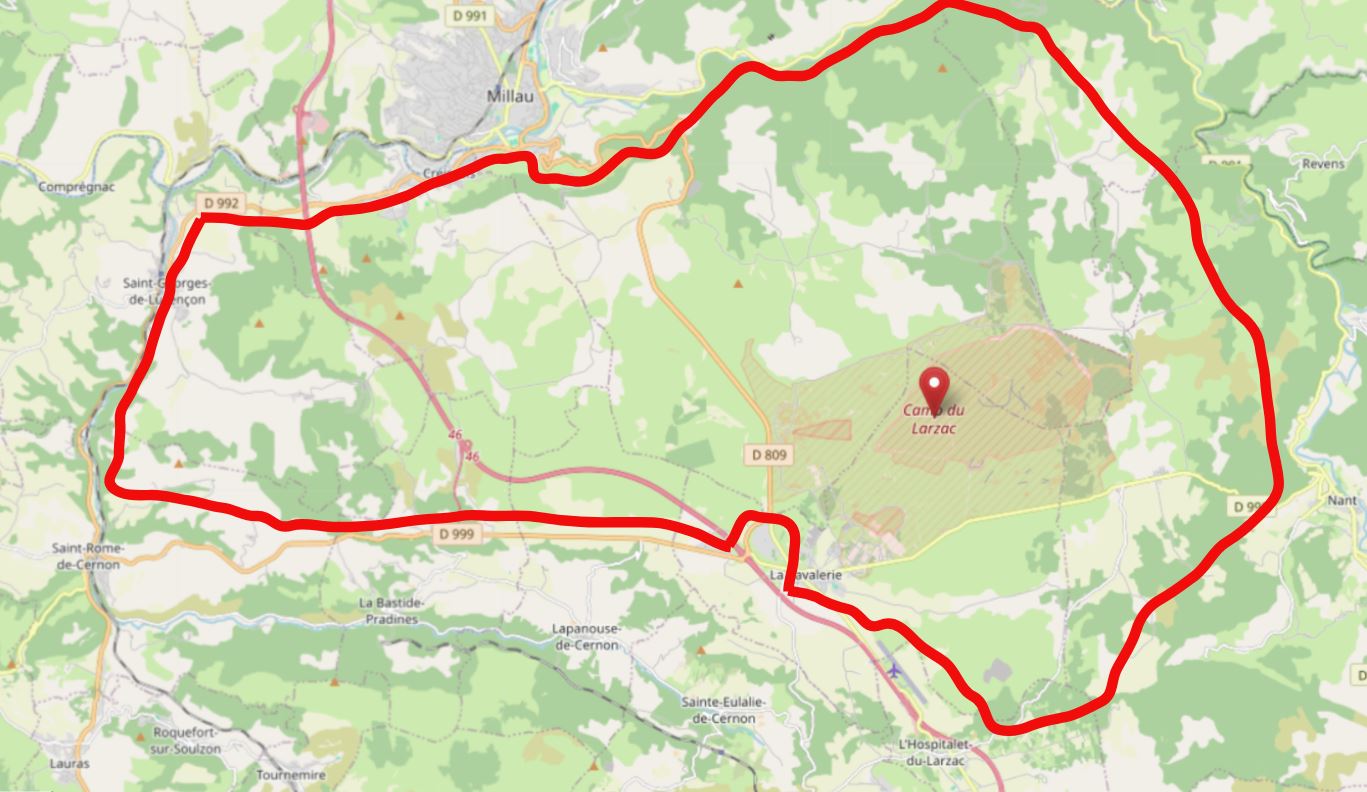
Camp du Larzac Erweiterung — Bernd Wältz (CC BY-SA 4.0). Source: larzac-peasants-campaign-to-block-expansion-of-military-camp-the.jpg

On November 6, 1971, 66,000 people demonstrated against the expansion in Millau [source: nv-database]. In March 1972, Gandhi disciple Lanza del Vasto led a fifteen-day fast with peasants, resulting in the ‘Oath of 103’ families pledging never to sell their land to the army [source: nv-database]. On July 14, 1972, 20,000 people protested in Rodez; on October 25, 1972, peasants brought sixty sheep to the Champs de Mars in Paris [source: nv-database]. In January 1973, a tractor march to Paris was blocked by riot police at Orleans [source: nv-database]. On June 10, 1973, volunteers began building an illegal sheepfold on the proposed camp site, completed in February 1974, which became a symbol of resistance [source: nv-database]. Three major rallies were held: August 1973 (80,000 people), August 1974 (over 100,000 people for a ‘Third World Harvest’ festival), and August 1977 (50,000 people with tractors) [source: nv-database]. In 1975, the journal ‘lo Gardarem Larzac’ was launched, reaching 4,000 subscribers [source: nv-database]. In October 1977, during a trial, farmers invaded the court with a flock of sheep; later that year, 5,000 people with 150 tractors plowed land bought by the army [source: nv-database]. On October 28, 1978, a national day of action included parades, rallies, and hunger strikes [source: nv-database]. In December 1978, 18 farmers marched 710 km to Paris, joined by 40,000 supporters at the city gates but blocked by riot police [source: nv-database]. In November 1980, 74 families camped under the Eiffel Tower for five days [source: nv-database]. The campaign also used tax refusal (withholding 3% of income tax that went to the military) and preclusive purchasing through agricultural land corporations (GFA) to prevent land sales to the army [source: nv-database]. When François Mitterrand was elected president in 1981, he officially abandoned the expansion project, having already announced the decision in June 1980 [source: nv-database].
Key people & organizations
- Michel Debre
- Lanza del Vasto
- Jose Bove
- François Mitterrand
- Jeuness Agricole Catholique (JAC)
- Chretiens danse le Monde Rural (CMR)
- FDSEA
- Paysans-Travailleurs
- LIP factory workers
- the 103
- Larzac Committees
- GFA (Groupement Foncier Agricole)
- Larzac University
- APAL (Association for the Advancement of Agriculture on the Larzac)
Outcome
Verdict: won.
The campaign achieved its goal when President Mitterrand canceled the expansion in 1981, a total victory. Success came from a decade of persistent nonviolent action, broad coalition-building (including church, union, and urban supporters), and the political shift brought by the 1981 election. [source: nv-database]
Lessons
- A clear, local grievance can mobilize a diverse coalition if the campaign remains focused on the core issue.
- Symbolic actions (like building a sheepfold) can create enduring symbols that unify and inspire supporters.
- Nonviolent discipline is crucial to maintain legitimacy and broad public support, even when external allies advocate violence.
- Combining legal pledges, civil disobedience, and political lobbying can create multiple pressure points on the target.
Sources
- Global Nonviolent Action Database —
nv-database
Disclaimer: Included as a teaching example of campaign craft, not as endorsement.
Sources & verification
nv-database— grounding: primary — license: link-only- Rewritten: 2026-06-25 via
worker_casestudies_v2.py