
Where it took place
| Type | Place |
|---|---|
| Region | Latin America |
| Country | Argentina |
Campaign at a glance
From 1977 to 1983, mothers and grandmothers of disappeared persons in Argentina protested the military dictatorship’s state terror, demanding the return of their loved ones and the restoration of democracy. Through weekly silent marches in the Plaza de Mayo, petitions, and international appeals, they grew from 14 to hundreds of members and inspired broader human rights activism. Their campaign contributed to the fall of the junta and the transition to democratic elections in 1983, though many never learned the fate of their children [source: nv-database].
Tactics used
- boycotts and strikes
- nonviolent direct action
- civil-resistance
- coalition building
- framing and narrative
- petitions and e campaigning
- methods-of-nonviolent-action
Background
After a 1976 coup, Argentina’s military junta under General Jorge Videla launched the ‘Dirty War,’ kidnapping, torturing, and killing up to 30,000 perceived subversives. A climate of fear and official denial prevented most from seeking the disappeared, but a small group of mothers began searching for their children and demanding accountability.
What happened
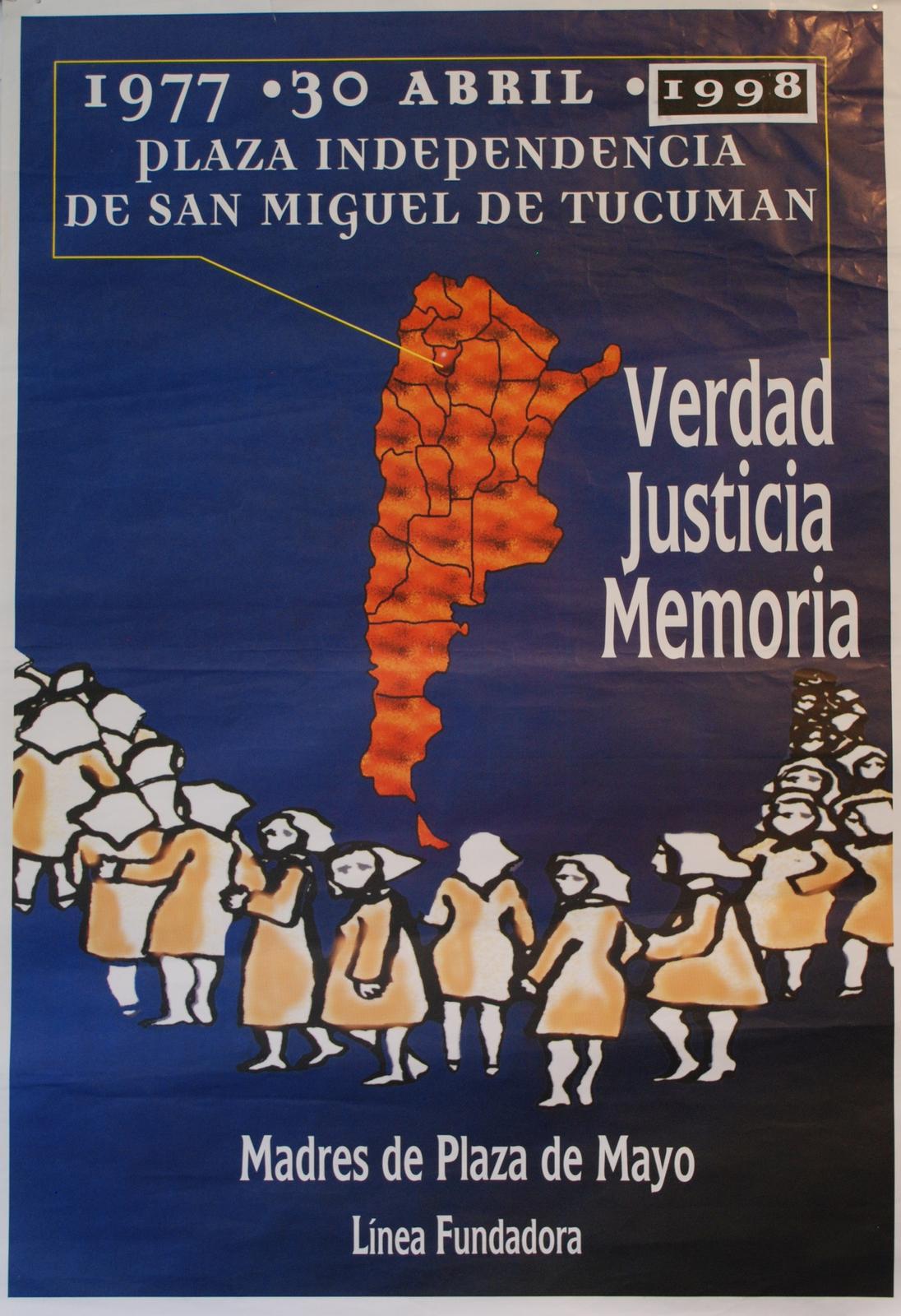
Madres de Plaza de Mayo — Tucumán, 1998 — Madres de Plaza de Mayo Línea Fundadora (CC BY-SA 4.0). Source: mothers-plaza-de-mayo-campaign-democracy-and-return-their-disappeared-family-members-1977-19.jpg

On April 30, 1977, fourteen mothers gathered at the Plaza de Mayo in Buenos Aires, initially sitting on benches and knitting to avoid police attention, then walking in pairs around the square [source: nv-database]. Over weeks, they used symbols like personal belongings and carpenter’s nails to communicate, and after two months three mothers met with the interior minister, who claimed ignorance of the disappearances [source: nv-database]. In September 1977, they joined the pilgrimage to Luján wearing their children’s nappies as headscarves, later embroidering names and ‘Aparición con Vida’ on them [source: nv-database]. They launched a letter campaign to human rights groups and placed a Mother’s Day ad in La Prensa, followed by a petition with 24,000 signatures and 537 names of the disappeared [source: nv-database]. By end of 1977, the group grew to about 150 members [source: nv-database]. In 1978, the Carter administration sent an envoy, and during the World Cup foreign journalists reported on the protests; some football players joined in solidarity [source: nv-database]. The government called the mothers ‘las locas’ and escalated repression, detaining, beating, and disappearing some leaders, including Azucena Villaflor de Vincenti [source: nv-database]. Despite this, the mothers formally registered as the Association of the Mothers of the Plaza de Mayo in August 1979, creating hundreds of linked chapters [source: nv-database]. The Inter-American Commission on Human Rights visited in August 1979 and condemned the junta [source: nv-database]. The mothers temporarily abandoned the plaza but returned by February 1980 [source: nv-database]. In April 1982, the regime attacked the Malvinas/Falkland Islands to regain support, but defeat led to the largest protest since the dictatorship, with 7,000 chanting against the regime [source: nv-database]. In October 1982, the mothers held a ‘march for life’; in December labor leaders organized a general strike, followed by two more [source: nv-database]. In June 1983, 50,000 people marched demanding truth about the disappeared [source: nv-database]. In July 1983, the dictatorship agreed to elections on October 30, and Raúl Alfonsín was elected president [source: nv-database]. After the transition, the mothers continued their weekly demonstrations, now seeking justice for the assassins [source: nv-database].
Key people & organizations
- Azucena Villaflor de Vincenti
- Haydé García Buelas
- Julia Gard
- Cándida Gard
- Berta Braverman
- María Adela Gard de Antokoletz
- Delicia González
- Pepa Noia
- Kety Neuhaus
- María Mercedes Gard
- Mirta Baravalle
- Raquel Arcushin
- Adolfo Pérez Esquivel
- Amnesty International
- Inter-American Commission on Human Rights
- Carter Administration
- General Jorge Videla
- Raúl Alfonsín
Outcome
Verdict: partial.
The campaign achieved 4 out of 6 specific goals, including the transition to democracy and survival of the movement, but many mothers never discovered the whereabouts of their children, resulting in a partial outcome [source: nv-database].
Lessons
- Persistent, disciplined nonviolent presence in a symbolic public space can challenge a repressive regime and attract international solidarity.
- Using maternal identity and symbols (like headscarves) can protect activists and frame the struggle in morally compelling terms.
- Building alliances with human rights organizations and leveraging international events (e.g., World Cup) amplifies pressure on a dictatorship.
Sources
- Global Nonviolent Action Database —
nv-database
Disclaimer: Included as a teaching example of campaign craft, not as endorsement.
Sources & verification
nv-database— grounding: primary — license: link-only- Rewritten: 2026-07-04 via
worker_casestudies_v2.py