
Where it took place
| Type | Place |
|---|---|
| Region | Latin America |
| Country | Peru |
Campaign at a glance
In December 1918, Peruvian workers, led by textile workers in Lima, launched strikes and a general strike to demand an eight-hour workday for all workers and wage increases. The campaign gained support from unions, students, and the Asamblea de Sociedades Unidas, and after a 48-hour general strike in January 1919, the government issued a decree establishing the eight-hour workday nationwide. Wage increases were not universally granted and were left for Congress to decide. [source: nv-database]
Tactics used
Background
In December 1918, male textile workers at El Inca factory in Lima walked off the job to protest a law that mandated an eight-hour workday for women and children but disrupted production and reduced male workers’ incomes. The workers demanded an eight-hour day for all workers and a 30-50% wage increase to maintain their living standards, but factory owners portrayed these demands as unreasonable, leading to public sympathy for the owners. [source: nv-database]
What happened
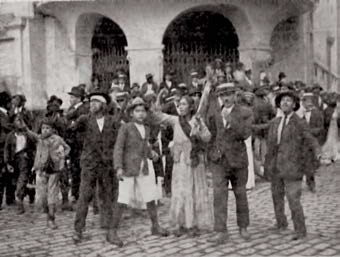
Workers demonstrating during the May 1919 general strike in Lima, Peru — Original de autor desconocido (año 1919) (Public domain). Source: peru-workers-use-general-strike-to-gain-8-hour-work-day-1919.jpg

On December 16, 1918, workers sent demands for an eight-hour day and wage increases to factory owners, who rejected them as unreasonable [source: nv-database]. Workers at Vitarte and El Inca factories struck on December 20, followed by other factories in the following days [source: nv-database]. On December 30, the Federacion de Obreros Panaderos struck, and agricultural workers from Huacho showed solidarity [source: nv-database]. The strike committee appealed to the Students Federation, which pledged support, and on January 6, 1919, the committee was renamed Comite Pro-Paro General [source: nv-database]. On January 10, the Asamblea de Sociedades Unidas passed a resolution supporting the strike [source: nv-database]. Police shut down the Student Federation building on January 12, but the committee met in secret and declared a 48-hour general strike starting January 13 [source: nv-database]. On January 13, militants urged workers to strike and picketed Lima’s commercial center, effectively shutting down the city [source: nv-database]. On January 15, Minister Manuel A. [source: nv-database] Vinelli met with the committee and student allies, was convinced to support the eight-hour day, and convinced President Jose Pardo to issue a decree establishing it nationwide [source: nv-database]. The committee then called off the strike [source: nv-database].
Key people & organizations
- Victor Raul Haya de la Torre [source: nv-database]
- Comite Pro-Paro General [source: nv-database]
- Students Federation [source: nv-database]
- Federacion de Obreros Panaderos Estrella del Peru [source: nv-database]
- Asamblea de Sociedades Unidas [source: nv-database]
- Manuel A. Vinelli [source: nv-database]
- Jose Pardo [source: nv-database]
- Felipe Chueca [source: nv-database]
- B. Bueno [source: nv-database]
- V. Quesada [source: nv-database]
Outcome
Verdict: partial.
The workers achieved the eight-hour workday for all workers via government decree, but wage increases were not universally granted and were left for Congress to decide, resulting in a partial victory. The campaign’s success was influenced by fears of violence similar to strikes in Argentina, which made President Pardo more responsive to the strikers’ demands. [source: nv-database]
Per the source’s scoring rubric, the campaign scored 2 out of 6 on achieving specific demands/goals, 1 out of 1 on survival, and 3 out of 3 on growth (6 out of 10 total). [source: nv-database]
Lessons
- A general strike can effectively shut down a city and force government negotiation.
- Building coalitions with students and other unions amplifies pressure and legitimacy.
- Sensationalist media coverage of similar movements elsewhere can make elites more willing to concede to avoid violence [source: nv-database]
Sources
- Global Nonviolent Action Database —
nv-database
Disclaimer: Included as a teaching example of campaign craft, not as endorsement.
Sources & verification
nv-database— grounding: primary — license: link-only- Rewritten: 2026-06-25 via
worker_casestudies_v2.py