
Where it took place
| Type | Place |
|---|---|
| Region | Africa |
| Country | Uganda |
Campaign at a glance
This research report by Oxfam and partners examines how climate change threatens coffee production in Uganda, where smallholder farmers produce 90% of the crop. [source: oxfam] Interviews with farmers in the Rwenzori Mountains reveal that they are aware of increasing climate unpredictability and have adopted various adaptation strategies. [source: oxfam] The report recommends measures to adapt coffee production and reduce the risk of smallholder farmers falling into deeper poverty. [source: oxfam]
Background
Coffee is a major cash crop in Uganda, but smallholder farmers who produce 90% of it face increasingly vulnerable livelihoods due to climate change. Arabica coffee can only be grown at high altitudes in Uganda, and rising temperatures are likely to further restrict suitable growing areas.
What happened
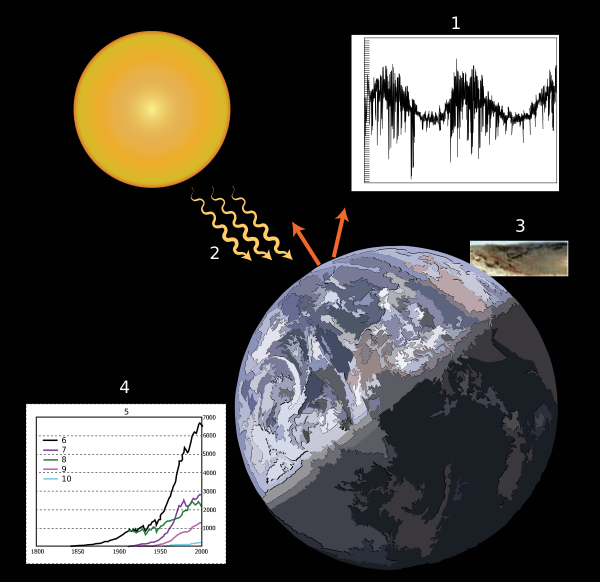
Lead photo. — Wikimedia Commons contributor (CC BY-SA 4.0). Source: the-impact-of-climate-change-on-coffee-in-uganda-lessons-from-a.svg
Oxfam’s research project interviewed coffee farmers in the Rwenzori Mountains and found that they are aware the climate is changing and becoming less predictable, and have used various adaptation strategies [source: oxfam]. For Arabica coffee, which can only be grown at high altitudes in Uganda, climate change and rising temperatures are likely to further restrict the areas in which it can be grown [source: oxfam]. The report makes recommendations for adapting coffee production in Uganda to reduce the impact of climate change on the economy and to reduce the risks that smallholder farmers will fall further into poverty [source: oxfam].
Key people & organizations
- Oxfam [source: oxfam]
- CIAT [source: oxfam]
- IITA-Uganda [source: oxfam]
- Jassogne, Laurence [source: oxfam]
- Laderach, Peter [source: oxfam]
- van Asten, Piet [source: oxfam]
Tactics used
The report uses framing-and-narrative to highlight the vulnerability of smallholder coffee farmers and to advocate for adaptation measures, aiming to influence policy and practice. [source: oxfam]
Outcome
Verdict: unknown.
The outcome is unknown because the source text is a research report that makes recommendations but does not document any subsequent changes or achievements resulting from those recommendations. [source: oxfam]
Lessons
- Research and documentation of local knowledge can strengthen advocacy for climate adaptation [source: oxfam]
- Targeted recommendations for specific crops and regions can help address the unique vulnerabilities of smallholder farmers.
Sources
- oxfam —
[[oxfam]]
Disclaimer: Included as a teaching example of campaign craft, not as endorsement.
Sources & verification
oxfam— grounding: primary — license: link-only- Rewritten: 2026-07-09 via T6 distillation (held_reason refreshed from no-raw to distilled-thin; canonical Oxfam URL recorded)