
Where it took place
| Type | Place |
|---|---|
| Region | Latin America |
| Country | Chile |
Campaign at a glance
From March 2011 to November 2013, Chilean students led a sustained campaign demanding free public education, an end to privatization, and lower student loan interest rates [source: nv-database]. The movement grew from 15,000 to 400,000 supporters and included marches, occupations, hunger strikes, and creative protests [source: nv-database]. Although the government did not fully meet their demands, the campaign influenced the election of Michelle Bachelet, who increased education funding and promised free university education for the poorest 60% by 2016 and all Chileans by 2020 [source: nv-database].
Tactics used
- unknown
Background
After dictator Augusto Pinochet privatized Chile’s education system in the 1970s, public schools remained underfunded, perpetuating inequality along socioeconomic lines. Despite the 2006 ‘Penguin Revolution’ protests, the government continued to privatize schools, leading the Confederation of Chilean Students (Confech) to launch a new campaign in April 2011 demanding free public education, subsidized tuition, lower loan interest rates, and equal access to quality schools [source: nv-database].
What happened
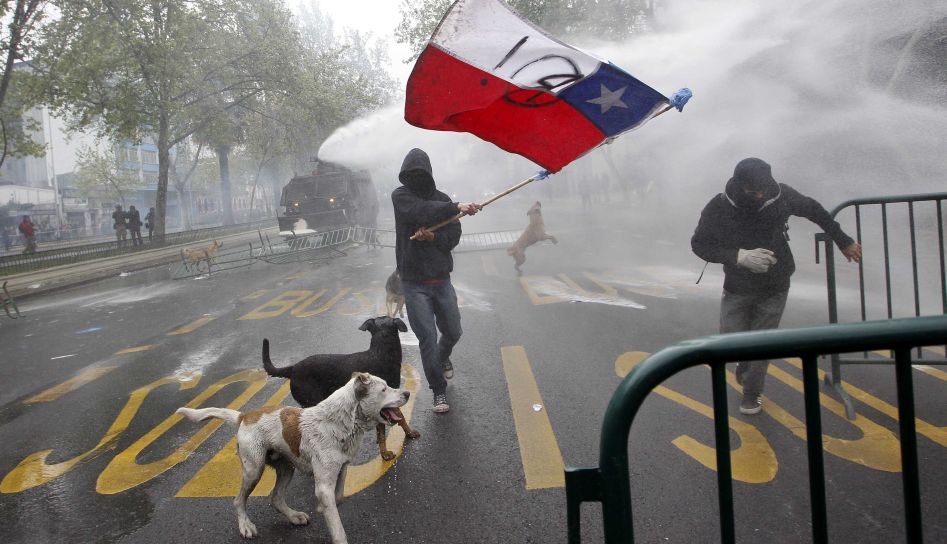
Lead photo. — Wikimedia Commons contributor (CC). Source: chilean-students-protest-for-free-public-education-2011-13.jpg
On 21 May 2011, students marched to the Chilean Congress where President Piñera was speaking; police used water cannons to disperse them, sparking the ‘Chilean Winter’ of protests [source: nv-database]. In June, students danced to Michael Jackson’s ‘Thriller’ wearing gravestone hats listing their debt, and on 30 June they occupied the headquarters of the Democratic Independent Union and the Socialist Party [source: nv-database]. The government proposed the Great National Education Agreement (GANE) on 4 July, allocating $4 billion for scholarships and lower loan rates, but students rejected it for not ending privatization [source: nv-database]. They staged a ‘kiss-in’ outside La Moneda Palace for 1800 minutes symbolizing the 1800 million pesos they wanted invested, followed by a pillow fight on 13 July [source: nv-database]. Throughout July, students held sit-ins, strikes, and about three dozen began hunger strikes [source: nv-database]. In August, police used water cannons and tear gas against peaceful marches; student leaders like Camila Vallejo advocated nonviolence despite some rock-throwing [source: nv-database]. Citizens joined with caceroladas (banging pots and pans), and the government offered the GANE and 21-point plans, which protesters refused as ambiguous and allowing for-profit colleges [source: nv-database]. Weekly marches continued through December 2011, with workers, teachers, and union members joining; on 15 October they participated in global anti-capitalist protests inspired by Occupy Wall Street [source: nv-database]. Students retreated temporarily to plan larger actions [source: nv-database]. On 15 March 2012, thousands marched in Santiago to protest the expulsion of 200 students from 2011 [source: nv-database]. In April, Education Minister Harald Beyer proposed lowering loan interest from 6% to 2%, but Gabriel Boric rejected it; students occupied more schools, and police evicted some while the Mayor of Santiago threatened to revoke scholarships [source: nv-database]. The campaign slowed from August 2012 but revived in March 2013 ahead of the November presidential election; thousands marched in Santiago, and police used tear gas, water cannons, and dogs [source: nv-database]. In June 2013, over 100,000 students protested alongside teachers, copper miners, and laborers; police continued arrests and tear gas use [source: nv-database]. Students occupied schools where primary elections were held, and presidential candidate Michelle Bachelet ran on a platform of education overhaul [source: nv-database]. After her November 2013 victory, Bachelet raised corporate taxes from 20% to 25%, generating about $5 billion for education, and promised free university for the poorest 60% by 2016 and all Chileans by 2020 [source: nv-database]. As of March 2015, she had increased corporate taxes to raise $8 billion annually and passed a law to gradually convert private primary and secondary schools from for-profit to nonprofit [source: nv-database]. Some student leaders like Gabriel Boric felt the reform was insufficient, while Camila Vallejo endorsed it as pragmatic [source: nv-database].
Key people & organizations
- Confederation of Chilean Students (Confech)
- Confederation of Students from the University of Chile
- Coordinating Assembly of Secondary School Students
- Confederation of Students from the Pontifical Catholic University of Chile
- Education 2020
- Chilean Central Workers’ Union (CUT)
- Middle School Coordinating Assembly
- Student Movement for Private Higher Education
- President Sebastián Piñera
- Camila Vallejo
- Gabriel Boric
- Michelle Bachelet
Outcome
Verdict: partial.
The movement achieved partial success: it did not end privatization, but it forced the government to increase education spending by $1.2 billion (a 10% rise), offer 24% more scholarships, and lower loan interest rates, and it propelled Michelle Bachelet’s election on a platform of free public education, leading to tax reforms and a plan for universal free university by 2020. [source: nv-database]
Lessons
- Creative, symbolic protests (like dancing to pop songs or staging a kiss-in) can generate widespread media coverage and public empathy.
- Building alliances with labor unions, teachers, and other social sectors can amplify pressure on the government.
- Strategic retreats to plan larger actions can help sustain a long-term campaign.
- Electoral engagement—supporting a candidate who adopts the movement’s demands—can translate protest power into policy change.
Sources
- Global Nonviolent Action Database —
nv-database
Disclaimer: Included as a teaching example of campaign craft, not as endorsement.
Sources & verification
nv-database— grounding: primary — license: link-only- Rewritten: 2026-06-25 via
worker_casestudies_v2.py