
Where it took place
| Type | Place |
|---|---|
| Region | Africa |
| Country | Egypt |
Campaign at a glance
Beginning in 1981, Hosni Mubarak ruled Egypt for over twenty-nine years. Though he ran for presidential reelection several times, elections were marked by widespread fraud, and opposing politicians were legally prohibited from running against Mubarak until 2005. [source: nv-database]
Tactics used
- affinity groups
- nonviolent direct action
- framing
- protests
Background
Beginning in 1981, Hosni Mubarak ruled Egypt for over twenty-nine years. Though he ran for presidential reelection several times, elections were marked by widespread fraud, and opposing politicians were legally prohibited from running against Mubarak until 2005. Virtually all key officials in government were from Mubarak’s National Democratic Party (NDP). Mubarak constructed a vast security apparatus to control public dissent; in the 1990s, citizens would only whisper his name for fear of reprisal. For his entire tenure as president, Egypt was in a legalized “state of emergency,” which legalized censorship, expanded police powers, and curtailed constitutional rights. The regime severely limited freedom of the press, and the state-run media were no more than a propaganda machine. Rumors abounded that Mubarak would eventually be replaced by his son Gamal, transforming Egypt’s supposedly electoral government into a de facto monarchy. Egyptian activists began to push the boundaries of the state’s tolerance for dissent in the 2000s. In 2004, a group of activists opposed to the Israeli occupation of Palestine and the United States war in Iraq formed a new campaign called the Kefaya (Enough) Movement, which targeted Mubarak and his family, and sought to prevent succession of the presidency to Gamal. Then, textile workers frustrated by Mubarak’s neoliberal policies launched a wave of strikes in 2006 and 2007, beginning in Mahalla and spreading across the country. From this point forward, public displays of dissent were not unusual, as they once were. Though there were often ten times as many police as protesters, workers and activists felt more confident taking to the streets to voice their concerns. The majority of the population, however, remained fearful of the regime. A group of activist youth formed the April 6 Movement in spring 2008, to support an industrial protest in Mahalla. After the Mahalla protest ended, April 6 continued to organize, using new tools such as Fa… [source: nv-database]
What happened
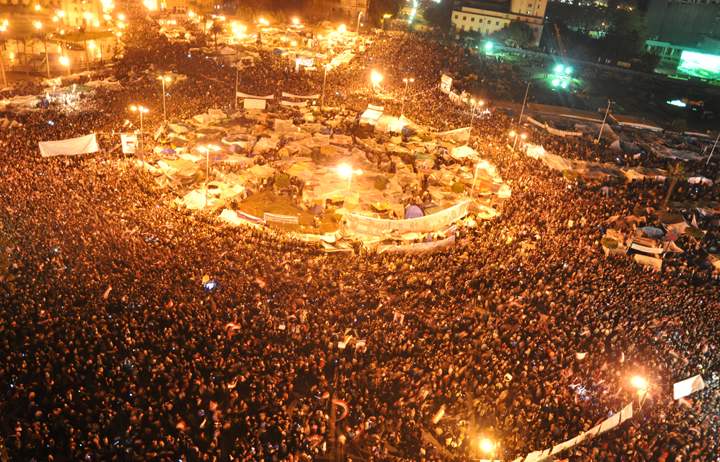
Lead photo. — Jonathan Rashad (CC BY 2.0). Source: egyptians-bring-down-dictatorship-of-hosni-mubarak-2011.png

nized and spontaneous. For his part, El-Baradei emphasized that the youth were the leaders of the revolution. The night before the “Day of Rage,” the Egyptian government ordered all Internet Service Providers in the country to cut off Internet service. The ISPs complied, and Internet traffic in Egypt immediately dropped to close to nothing. This was the first time in history that a government had cut off all Internet access to its people. In doing so, Mubarak’s regime believed it would hinder the organization of the protesters. The regime also hindered cell phone access, although it could not cut it off entirely. The following day, after midday prayer services, hundreds of thousands of Egyptians streamed into the streets across Egypt. In Cairo, people followed directions printed and distributed by youth organizers, which instructed individuals to gather their neighbors and start marching toward the center city and Tahrir Squre. Materials distributed by April 6 and other organizers also stressed the importance of remaining nonviolent and maintaining a positive attitude. Police attempted to obstruct demonstrators in all parts of the city, using live ammunition in some cases. One major confrontation occurred at the Kasr al-Nil Bridge, where police armed with gas, water cannons and truncheons sought to beat back a swelling crowd of demonstrators. For the most part, demonstrators did not engage in hand-to-hand combat with the police, choosing instead to surpass them nonviolently by the strength of their numbers. The government announced a 6 pm curfew, but almost nobody paid attention to it. When it became clear that protesters were not intimidated into leaving the streets, the regime withdrew the police forces from Cairo. Demonstrators burned abandoned police vans, and also lit fire to the National Democratic Party headquarters. Many Egyptians spoke of a “fear barrier” that had been broken by the day of conflict with the police, in which the numbers and bravery of the protesters prevailed. After police vanished from Cairo, the national army entered the city. Aware that the army would be an important arbiter of power, demonstrators cheered to welcome the soldiers, gave them hugs, and chanted slogans like “The People and the Army are One Fist.” The army announced its intention to protect the people of Egypt, and emphasized that it would not fire on civilians. Later that night, Mubarak appeared on state-run television and announced that he would dismiss his cabinet. This statement did not appease the demonstrators. Several hundred remained in Tahrir Square overnight, and vowed to stay until Mubarak stepped down. On January 29, police did not return to the capital. Approximately 50,000 people gathered in Tahrir Square again to demand that Mubarak resign. Organizers of the protests encouraged people not to chant slogans supporting any particular party, but to project a message of unity and courage. Official statements by organizers emphasized the diverse nature of the demonstrators, who crossed lines of class, gender, and religion. In Tahrir Square, people took turns sweeping and cleaning up garbage, to prove that the Egyptian people could take care of themselves without the iron hand of the police. People quickly convened “citizens’ patrols” in Cairo’s neighborhoods to prevent looting or violence. Meanwhile, the regime amplified any slight incident involving violence or disorder in order to portray the crowds as dangerous and chaotic. On Saturday evening, Mubarak swore in the Head of Intelligence, Omar Suleiman, as his new vice president. Suleiman made gestures toward the organizers of the resistance, but the organizers said that they would not negotiate with the government until Mubarak was no longer in power. By this point, the events in Egypt had captured the attention of people across the world. The Al Jazeera news network provided 24-hour coverage of the protests in Arabic and English, despite intimidation of its reporters by the regime. International allies organized solidarity rallies in many countries, including the United States. American activists called on President Barack Obama to cut off its financial assistance to Egypt. Further aid came from the American company Google, which developed “speak2tweet” technology that allowed activists to post to Twitter over their phones, without Internet access. On January 31 and February 1, activists further developed the encampment in Tahrir Square, building a tent city in the center, and barricades around the perimeter of the square. Over two million people filled the square on February 1 to continue to pressure the regime. The square acquired a potent symbolic value—people had the feeling that, as long as there were demonstrators in the square, the revolution was alive. Egyptian state television attempted to convince people to return to their “safe, stable lives,” and emphasized the stories of people who were inconvenienced or losing business due to the protests. I… [source: nv-database]
Key people & organizations
- April 6 Movement, We Are All Khaled Said, Wael Ghonim [source: nv-database]
- Mohammed El-Baradai, National Association for Change, Youth for Justice and Freedom, Popular Democratic Movement for Change, Kefaya Movement, Muslim Brotherhood, and the Ghad, Karama, Wafd and Democratic Front political parties [source: nv-database]
- Human rights lawyers provided legal support for jailed protesters and documented the abuses of the police forces. The Al Jazeera news network provided excellent coverage that was favorable to the revolutionaries, despite intimidation and detainment of its reporters by the regime. Solidarity activists in United States, Europe and elsewhere marched and rallied in support of the campaign. Google developed technology that allowed people to post to twitter without internet access, and set up a resource page to provide information to citizen activists. [source: nv-database]
- Opponents: President Hosni Mubarak, his cabinet, and his National Democratic Party [source: nv-database]
- Classification: Change [source: nv-database]
Outcome
Verdict: won.
The “6” rating for success is only for the goal of ousting Mubarak. Success of the broader goals of the revolution is not yet determined. [source: nv-database]
GNVAD scoring: survivalgoals=1 out of 1 points, total points=10 out of 10 points, growth=3 out of 3 points [source: nv-database]
Lessons
- Sustained nonviolent action can shape public perception and force concessions even when immediate demands are not met.
- Cross-class, cross-sectarian, or cross-partisan coalitions amplify reach and dilute regime repression.
Sources
- Global Nonviolent Action Database —
nv-database
Disclaimer: Included as a teaching example of campaign craft, not as an endorsement.
Sources & verification
nv-database— grounding: primary — license: link-only- Last verified: 2026-07-04