
Where it took place
| Type | Place |
|---|---|
| Region | Asia |
| Country | Palestine |
Campaign at a glance
In May 2010 the Free Gaza Movement launched a flotilla to deliver humanitarian aid to the Gaza Strip and challenge Israel’s blockade of the strip. This was the ninth mission the Free Gaza Movement had launched, although the last three missions had been blocked by the Israeli Navy. [source: nv-database]
Tactics used
- protests
Background
In May 2010 the Free Gaza Movement launched a flotilla to deliver humanitarian aid to the Gaza Strip and challenge Israel’s blockade of the strip. This was the ninth mission the Free Gaza Movement had launched, although the last three missions had been blocked by the Israeli Navy. This flotilla included eight ships, while the past flotillas had only included one or two. Three ships carried passengers as well as humanitarian aid, while the rest just carried passengers. The flotilla consisted of two Greek ships, two from the US, and one each from Comoros, Turkey, Kiribati, and Cambodia. They carried over 10,000 tons of humanitarian aid. This included food, medicine, and clothing as well as materials that the Israeli authorities forbade, such as cement. The flotillas included 663 passengers in total and 600 sailed on the ship the Mavi Marmara. Over half the passengers were Turkish, but there were passengers from 37 countries in total. The passengers also included the former UN Assistant Secretary General Denis Halliday, a Holocaust survivor, Nobel Peace Prize laureate Mairead Corrigan Maguire, and an Israeli-Arab Knesset member. Following the announcement of the flotilla, Israel challenged the organizers’ plan. It both questioned the flotilla’s motives and said that it would violate international law. Israel offered for the flotilla to dock in Ashdod and to then transfer the supplies to the Gaza Strip, including the materials not allowed by the blockade. Activists preferred to deliver the humanitarian supplies and break the blockade. End the blockade of the Gaza Strip. [source: nv-database]
What happened
Lead photo. — Israel Defense Forces (CC BY 2.0). Source: freedom-flotilla-gains-partial-victory-eases-blockade-of-the-gaza-strip-2010.jpg

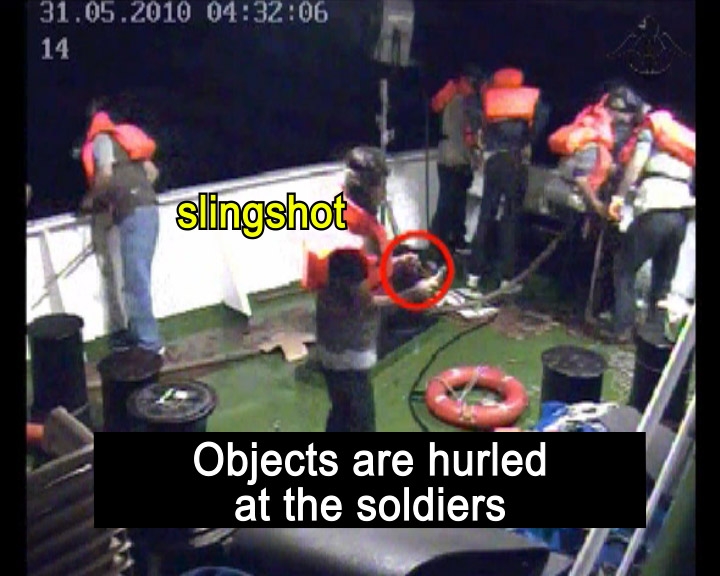
Gaza Strip, including the materials not allowed by the blockade. Activists preferred to deliver the humanitarian supplies and break the blockade. Also, they did not trust that the supplies would be delivered by the Israelis. As a result, they did not agree to the Israeli proposition. Six of the ships set sail from international waters off the coast of Cyprus on 30 May, while two had mechanical problems and did not launch. On 31 May, Israeli authorities communicated to the ships that they should redirect their path to Ashdod, but the ships replied that they intended to go to Gaza. During the night of the 31st, after the flotilla did not comply with Israeli directives, troops began to mobilize. Helicopters approached the ship and heavily armed troops rappelled down. The heaviest attack targeted the Mavi Marmara, but troops also boarded the other ships. They carried tear gas, stun grenades, and guns. All the passengers on the ships excluding the Mavi Marmara reacted nonviolently. Many passengers on the Mavi Marmara tried to find shelter and acted nonviolently. However, after it became clear that Israeli soldiers would board the ship, some passengers responded violently. This does not appear to have been a planned reaction or condoned by the leaders of the flotilla, but there also does not seem to have been a total agreement to nonviolence beforehand. During their assault on the Mavi Marmara, Israeli troops beat and opened fire on the primarily nonviolent activists. Some activists used chains, clubs, and perhaps even knives as weapons against the attacking commandos. Activists heavily beat some commandoes, and soldiers beat and shot many activists. In the end, the clashes injured many activists and killed nine, while they injured seven soldiers. After the fights ended, Israeli forces towed the ships to shore in Israel. Israeli authorities agreed to deliver the goods from the ships that the terms of the blockade did not forbid. However, Hamas insisted that they wanted to break the blockade instead of just receiving goods, and they refused the entry of any goods unless Israel delivered all of them. As a result, Israel never delivered the goods. Nevertheless, on 17 June Israel announced a relaxation of the blockade. After the Israeli authorities towed the ships to shore, they placed the activists in detention. Israel began releasing activists on 1 June, and they immediately deported all the activists after their release. Israel released and deported 300 activists on 2 June. Some activists continued to be held for several days, and Israel released the last activists on 6 June. Israel received severe criticism as a result of their attack on the ships. The UN eventually released a report criticizing Israel’s actions. Israel’s relationship with Turkey also suffered. Research Notes [source: nv-database]
Key people & organizations
- Turkish activists, distinguished figures [source: nv-database]
- Turkish government [source: nv-database]
- Opponents: Israeli government [source: nv-database]
- Classification: Third-party nonviolent intervention [source: nv-database]
Outcome
Verdict: won.
been a total agreement to nonviolence beforehand. During their assault on the Mavi Marmara, Israeli troops beat and opened fire on the primarily nonviolent activists. Some activists used chains, clubs, and perhaps even knives as weapons against the attacking commandos. Activists heavily beat some commandoes, and soldiers beat and shot many activists. In the end, the clashes injured many activists and killed nine, while they injured seven soldiers. After the fights ended, Israeli forces towed the ships to shore in Israel. Israeli authorities agreed to deliver the goods from the ships that the terms of the blockade did not forbid. However, Hamas insisted that they wanted to break the blockade instead of just receiving goods, and they refused the entry of any goods unless Israel delivered all of them. As a result, Israel never delivered the goods. Nevertheless, on 17 June Israel announced a relaxation of the blockade. After the Israeli authorities towed the ships to shore, they placed the activists in detention. Israel began releasing activists on 1 June, and they immediately deported all the activists after their release. Israel released and deported 300 activists on 2 June. Some activists continued to be held for several days, and Israel released the last activists on 6 June. Israel received severe criticism as a result of their attack on the ships. The UN eventually released a report criticizing Israel’s actions. Israel’s relationship with Turkey also suffered. Research Notes [source: nv-database]
GNVAD scoring: survivalgoals=1 out of 1 points, total points=3 out of 10 points, growth=0 out of 3 points [source: nv-database]
Lessons
- Sustained nonviolent action can shape public perception and force concessions even when immediate demands are not met.
- Cross-class, cross-sectarian, or cross-partisan coalitions amplify reach and dilute regime repression.
Sources
- Global Nonviolent Action Database —
nv-database
Disclaimer: Included as a teaching example of campaign craft, not as an endorsement.
Sources & verification
nv-database— grounding: primary — license: link-only- Last verified: 2026-07-04
Learn more
- On Wikipedia: 2010 Gaza Freedom Flotilla — CC BY-SA 4.0