
Where it took place
| Type | Place |
|---|---|
| Region | Latin America |
| Country | Haiti |
Campaign at a glance
From February 1986 to late 1987, a coalition of more than 90 political, labor, religious, and popular organizations tried to force General Henri Namphy’s National Governing Council (CNG) from power and replace it with a civilian government that would hold honest elections. [source: nv-database] The campaign used every nonviolent lever available — general strikes, election boycotts, leaflet campaigns, theatre, mock funerals, an announced mass self-immolation — but failed to dislodge the CNG. The presidential election eventually held on November 29, 1987 was violently shut down within hours of opening. The campaign scored 5 of 10 on the source’s rubric; the goal of a civilian government was not achieved and the goal of free elections was not achieved within the campaign horizon, although elections did come three years later. [source: nv-database]
Tactics used
- general-strike
- marches
- declarations-by-organizations-and-institutions
- petitions
- nonviolent direct action
- election-boycott
Background
When President-for-Life Jean-Claude Duvalier fled Haiti on February 7, 1986, he left the country in the hands of a six-member National Governing Council under army commander Henri Namphy. [source: nv-database] In the months that followed, the economy stalled, the former Tonton Macoutes remained active, and opposition figures began demanding “dechouker” — a Creole term for the uprooting of the regime and its replacements. The Catholic Church, labor unions, and a constellation of political parties — including the Haitian Christian Democratic Party led by Sylvio Claude, the radical priest Jean-Bertrand Aristide, and the strike-committee coalition assembled by Jean-Claude Bajeux and Serge Gilles — coalesced into a coalition leadership calling itself the Committee of 57. [source: nv-database]
What happened
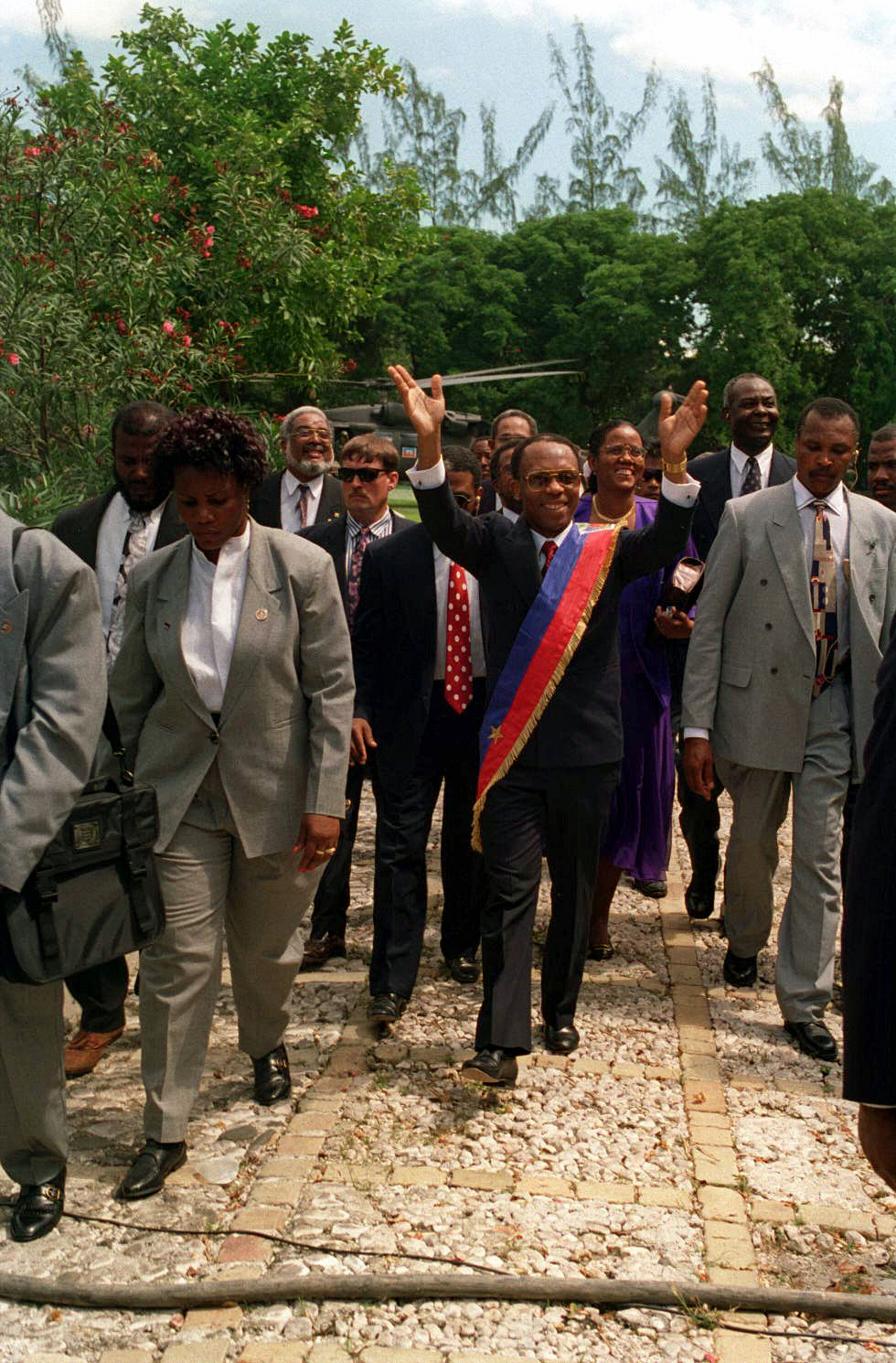
Lead photo. — TSGT Val Gempis (USAF) (Public domain). Source: haitians-demand-civilian-government-and-democratic-elections-1986-88.jpg

In the first weeks, over 10,000 protesters marched in Port-au-Prince demanding a civilian government; some were killed by police. [source: nv-database] Bus drivers’ near-total compliance with strike calls became a defining feature of the campaign: their refusal to run halted the capital’s workforce. The opposition set out four explicit demands: that three CNG members with ties to Baby Doc resign, that the council be dissolved, that a civilian government be formed, and that the CNG begin immediate talks with the campaign. In March 1986, Namphy promised to dismiss the three members and remove the curfew, but he refused to step down. [source: nv-database]
The opposition boycotted the October 1986 elections for a constituent assembly. In November 1986, the labor movement launched a wave of strikes focused on the IMF-backed economic policies; soldiers arrested six labor leaders including the co-head of the Autonomous Central of Haitian Workers (CATH) and shut the union down. [source: nv-database]
On March 29, 1987, voters approved a new constitution with 99% support. By mid-June the Committee of 57 had the formal backing of more than 90 organizations. That month, the CNG announced elections for August 1987 under voting rules it had drafted itself; secondary-school graduates in several towns threatened to boycott final exams in protest, and within two weeks the government agreed to revoke its decree and return oversight to the electoral council. [source: nv-database]
On the announced date, July 7, 1987, thousands of people gathered at the National Palace to watch twenty-one university students self-immolate; the students did not appear. The opposition expanded its tactics to include radio and newspaper parodies of Namphy, dramatized plays mocking the regime, and demonstrative funerals for slain protesters. [source: nv-database]
In November 1987 the presidential election opened; within hours, armed groups destroyed ballots and killed voters. The source notes that the eventual Haitian elections came three years later, long after the bulk of this campaign had subsided. [source: nv-database]
Key people & organizations
- General Henri Namphy — head of the National Governing Council
- Sylvio Claude — leader of the Haitian Christian Democratic Party
- Jean-Claude Bajeux — coalition leader and strike-committee member
- Serge Gilles — coalition leader
- Daniel Narcisse — strike-committee member
- Father Jean-Bertrand Aristide — popular Catholic leader who emerged from this campaign
- Jean Auguste Mesyeux — co-leader of CATH, arrested during the June 1987 strike wave
- Committee of 57 — coordinating body of more than 90 political, labor, religious, and popular organizations
Outcome
Verdict: lost.
The campaign scored 1 of 6 on achieving its core demands: Namphy did not run in the end, but he never planned to; and the goal of free elections failed when the November 1987 vote was violently shut down within hours. [source: nv-database] The Committee of 57 dissolved soon after. The coalition did succeed in forcing the CNG to adopt a new constitution and to give back electoral oversight of the November vote — tactical wins — but the rigged ballot that followed destroyed what remained of the campaign’s leverage. Father Jean-Bertrand Aristide, an emerging Catholic leader within the coalition, would go on to win the presidency in 1990, three years after the bulk of this campaign subsided. [source: nv-database]
Lessons
- A transitional regime that inherits a dictatorship’s instruments of repression rarely concedes to a popular coalition in less than a year; sustained pressure is the precondition for any movement that hopes to outlast its own initial momentum.
- Election boycotts are high-risk: they require sustained turnout discipline and can be reframed by opponents as political irrelevance; the alternative — participating in a clearly rigged vote — has its own high costs.
- A single dramatic tactic announced in advance (here, the threatened mass self-immolation) may draw tens of thousands but loses leverage when the action is cancelled; subsequent threats are discounted.
Sources
- Global Nonviolent Action Database — Haitians demand civilian government and democratic elections, 1986-88 —
nv-database
Disclaimer: Included as a teaching example of campaign craft, not as endorsement.
Sources & verification
nv-database— grounding: primary — license: link-only / all-rights-reserved (ND-style; content paraphrased, not quoted)- Verified: 2026-07-04 by human