
Where it took place
| Type | Place |
|---|---|
| Region | Asia |
| Country | Iraq |
Campaign at a glance
In the 1960s, the Iraqi government began nationalizing the oil industry. [source: nv-database]
In 1966, the government created the Iraq National Oil Company, which was to eventually control all sects of the oil industry except for refining which was already under control of the Oil Refineries Administration. [source: nv-database]
Tactics used
- protests
Background
In the 1960s, the Iraqi government began nationalizing the oil industry. [source: nv-database]
In 1966, the government created the Iraq National Oil Company, which was to eventually control all sects of the oil industry except for refining which was already under control of the Oil Refineries Administration. [source: nv-database]
Complete nationalization occurred in 1972. [source: nv-database]
Iraq has a proven 115 billion barrels of oil reserves, the third largest amount in the world. [source: nv-database]
In 2004, United States President George W. [source: nv-database]
Bush commissioned the consulting firm BearingPoint to devise a law privatizing Iraq’s oil industry. [source: nv-database]
The resulting Iraqi Oil Law, also known as the Iraqi Hydrocarbon Law, was endorsed by the Iraqi cabinet in February 2007. [source: nv-database]
In May 2007, the oil law was proposed to the Iraqi Council of Representatives. [source: nv-database]
The legislation would have created production share agreements, securing profits for the major international oil companies and leaving the Iraqi government to distribute the rest of the profits on a per capita basis. [source: nv-database]
The law also would have reduced the Iraq National Oil Company’s control of the country’s 80 oil fields to just 17. [source: nv-database]
Many political parties, as well as a group of 60 senior Iraqi oil experts, and all of the country’s trade unions opposed the oil law. [source: nv-database]
The major organized opposition was the Iraqi Federation of Oil Unions (IFOU), the country’s largest oil trade umbrella union comprising of 26,000 members. [source: nv-database]
The Federation had previously requested civil society inclusion in negotiations over the law, but was denied the right. [source: nv-database]
The IFOU demanded “improved working conditions, pay, land for homes, a reduction in the national price of fuel and crucially, inclusion in the Oil Law drafting process.” IFOU President Hassan Jumaa Awad al-Assadi stated: ‘The oil law does not represent the aspirations of the Iraqi people. [source: nv-database]
It will let the foreign oil companies into the oil sector and enact privatisation under so called production sharing agreements. [source: nv-database]
The federation calls for not passing the oil law, because it does not s… [source: nv-database]
What happened
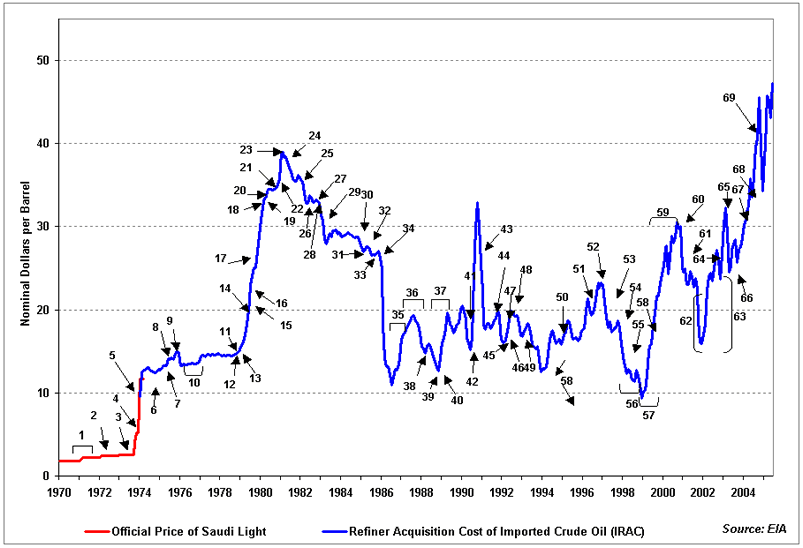
Oil Price Chronology 1970-2005 — Wikimedia Commons contributor (Public domain). Source: iraqi-workers-strike-against-oil-law-2007.gif

nnounced these plans and their demands. In addition to the IFOU’s rejection of the oil law and wish to be included in negotiations as a third party, the organization identified other issues within the industry; during previous months the union and the government had held talks over workers’ concerns regarding wages, health, safety, and the use of temporary workers, but none of these had been met. In the letter, the IFOU specifically asked for “a previously agreed bonus that is based on the distribution to workers of a proportion of oil revenues achieved by the company, no salary deductions to be made for granted vacation days, and the delivery of land parcels for housing to workers.” Al-Assadi had also outlined these demands at a meeting in Amman, Jordan with representatives from the International Federation of Chemical, Energy, Mine and General Workers’ Unions, the Trades Union Congress of the UK, and Jordan’s Office of the International Trade Union Confederation. Most importantly, the IFOU’s proposed strike would stop production at all of Iraq’s oil companies in Basra, Misan, Thi-Qar and Muthanna, which would effectively freeze most of Iraq’s economy, impacting all domestic products and halting exportation of crude oil. The strike would remove 1.6 million barrels of oil per day from the market. The sales of that much oil funded 93% of the federal government’s budget. Frightened, Prime Minister Nouri al-Maliki and the Ministry of Oil organized negotiations with a delegation from the IFOU, including al-Assadi. The IFOU thus temporarily postponed the strike. Meanwhile, on May 13, al-Assadi sent a letter to the United States Congress condemning the law. One statement read, “Everyone knows the oil law doesn’t serve the Iraqi people.” On May 16, the IFOU presented its demands to al-Maliki and his delegation. They asked for “improved working conditions, pay, land for homes, a reduction in the national price of fuel and crucially, inclusion in the Oil Law drafting process.” Al-Maliki responded by creating a committee with members from the Ministry of Oil, IFOU, and Southern Oil Company tasked with finding a way to act on the demands. No developments occurred in May and so the IFOU decided to strike. On Monday June 4, workers at the Iraqi Pipelines Company in Basra refused to work, thus disabling oil products, including kerosene and gas, to flow from the rigs at the pipelines to the refinery in Baghdad. Workers of the Iraqi Pipeline Union, a member of the IFOU, struck at 6:30 a.m. and shut down two 14” pipelines. The strikers also threatened to shut off pipeline 48, which transferred crude oil to Baghdad, if their demands were not met. Prime Minister Nouri al-Maliki sent troops to surround the protesters and issued arrest warrants for the organizers. None of the leaders were arrested, however. U.S. fighter jets also flew over the strikers, in an attempt at intimidation and repression. On June 6, after striking for just two days, the IFOU agreed to postpone the strike for five days after al-Maliki announced that he was sending a delegation to Basra to talk with IFOU representatives. On the 11th, the date the IFOU had set to restart the strike, al-Assadi announced the cancellation of the protest because the government had created a committee to address their demands. Naftana, a Britain-based solidarity group, translated and disseminated al-Assadi’s public statement. Fearing renewal of the strike, al-Maliki also conceded to the IFOU’s main demand and announced he would delay the oil law decision until October. No decision was made in October and as of November 2011 Iraq is still debating the oil law. Research Notes [source: nv-database]
Key people & organizations
- IFOU President Hassan Jumaa Al-Assadi al-Assadi [source: nv-database]
- Naftana, The International Federation of Chemical, Energy, Mine and General Workers’ Unions, the Trades Union Congress of the UK, and Jordan’s Office of the International Trade Union Confederation [source: nv-database]
- Opponents: The Iraqi government, the U.S. government [source: nv-database]
- Classification: Defense [source: nv-database]
Outcome
Verdict: won.
The IFOU was successful in forcing the Iraqi government to listen to its demands. The law was also never acted upon. [source: nv-database]
GNVAD scoring: survivalgoals=1 out of 1 points, total points=9 out of 10 points, growth=2 out of 3 points [source: nv-database]
Lessons
- Sustained nonviolent action can shape public perception and force concessions even when immediate demands are not met.
- Cross-class, cross-sectarian, or cross-partisan coalitions amplify reach and dilute regime repression.
Sources
- Global Nonviolent Action Database —
nv-database
Disclaimer: Included as a teaching example of campaign craft, not as an endorsement.
Sources & verification
nv-database— grounding: primary — license: link-only- Last verified: 2026-07-04