
Where it took place
| Type | Place |
|---|---|
| Region | North America |
| Country | United States |
Campaign at a glance
In 1919, immigrant textile workers in Lawrence, Massachusetts, struck for a 48-hour work week without a pay cut, using the slogan ‘54-48!’. [source: nv-database]
The strike involved up to 30,000 workers, faced severe police repression, and ended after the United Textile Workers negotiated a 48-hour week with a 15% wage increase, exceeding the strikers’ original demand. [source: nv-database]
The campaign achieved its main goal of maintaining wages while reducing hours. [source: nv-database]
Tactics used
- boycotts and strikes
- civil-resistance
- coalition building
- nonviolent direct action
Background
In 1919, the United Textile Workers and Central Labor Union negotiated a reduction of the work week from 54 to 48 hours, but with an overall wage cut. [source: nv-database]
Immigrant workers in Lawrence, Massachusetts, already struggling with wages below the cost of living, could not afford the decrease. [source: nv-database]
Inspired by a successful 1912 strike in Lawrence, they decided to strike to keep their pay while reducing hours. [source: nv-database]
What happened
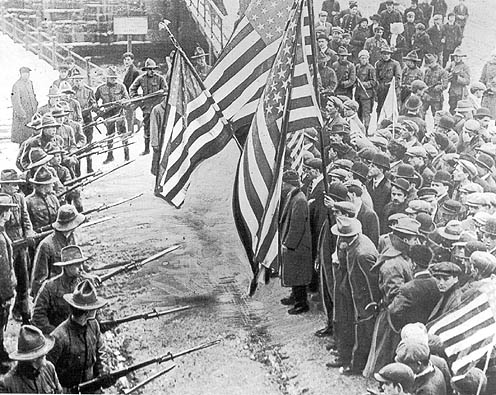
1912 Lawrence Textile Strike 1 — Wikimedia Commons contributor (Public domain). Source: lawrence-mill-workers-strike-against-wage-cuts-1919.jpg

On 3 February 1919, between 17,000 and 30,000 immigrant workers walked out of Lawrence mills, beginning the ‘54-48’ strike. [source: nv-database] The strikers organized among twenty ethnic groups with one leader per group and invited three pastors (A. [source: nv-database] J. [source: nv-database] Muste, Cedric Long, Harold Rotzel) as spokespeople. [source: nv-database] Ethnic stores supported the strikers by accepting coupons, and strikers boycotted non-supporting stores [source: nv-database]. The city administration, led by Mayor John Hurley, banned mass gatherings, restricted news coverage, regulated travel, and kept mills under police surveillance. [source: nv-database] Police beat strikers on the picket line; Muste and Long were beaten and arrested but acquitted a week later [source: nv-database]. On 18 February, women strikers appealed to Governor Coolidge, who refused to meet them. [source: nv-database] On 21 February, police beat and arrested about 3000 strikers at a meeting near a garbage dump. [source: nv-database] A machine gun was displayed for intimidation on 5 May, and on 6 May two immigrant leaders, Anthony Capraro and Nathan Kleinman, were kidnapped and beaten [source: nv-database]. Boston radicals and the Amalgamated Clothing Workers of America donated thousands of dollars to the strike fund. [source: nv-database] Elizabeth Glendower Evans visited, gave money, led a silent march, and boosted morale. [source: nv-database] By mid-March, the city faced financial strain from policing and the boycott depressed store profits. [source: nv-database] Mayor Hurley formed a Business and Professional Men’s Committee to arrange a meeting, but mill owners refused. [source: nv-database] In early April, Governor Coolidge forced state arbitration; hearings lasted nearly a month but no compromise was reached, though it was the first direct communication between sides [source: nv-database]. In mid-May, the United Textile Workers negotiated with mill owners without the strikers’ knowledge, securing a 48-hour week and a 15% wage increase. [source: nv-database] The strike had run out of funding. [source: nv-database] On 19 May, as Muste prepared to announce failure, mill owners called him to the conference and explained the new agreement. [source: nv-database] Muste added a non-discrimination clause, and on 20 May 1919 the strike ended [source: nv-database].
Key people & organizations
- A. J. Muste
- Cedric Long
- Harold Rotzel
- Thomas G. Connolly
- Elizabeth Glendower Evans
- Amalgamated Clothing Workers of America
- United Textile Workers
- Mayor John Hurley
- Governor Calvin Coolidge
- Anthony Capraro
- Nathan Kleinman
- Angelo Rocco
Outcome
Verdict: won.
The campaign achieved its goal of a 48-hour work week with no pay cut, and even secured a 15% wage increase, exceeding the original demand. The outcome is considered a win because the strikers’ core demand was met, despite the strike ending through union negotiation rather than direct victory. [source: nv-database]
Lessons
- Building broad coalitions across ethnic groups and with external allies can sustain a strike financially and morally.
- Nonviolent discipline in the face of severe repression can attract sympathy and support from influential outsiders.
- Direct communication between strikers and opponents, even through arbitration, can open pathways to resolution.
Sources
- Global Nonviolent Action Database —
nv-database
Disclaimer: Included as a teaching example of campaign craft, not as endorsement.
Sources & verification
nv-database— grounding: primary — license: link-only- Rewritten: 2026-06-25 via
worker_casestudies_v2.py